
Common Good News · VeteransBien commun nouvelles · Vétérans
Veterans NewsNouvelles des vétérans
Page type: NewsType de page : Nouvelles
News and work that touches veterans, in one place.Les nouvelles et le travail qui touchent les vétérans, au même endroit.
Veterans News · The Follow-Through LedgerNouvelles des vétérans · Le registre de suivi
Asked, and followedDemandé, et suivi
This is the part we keep — and have not seen another outlet keep: every question Common Good News has asked an institution about veterans, on the record — and the ones still waiting for an answer stay at the top, in the open, until the answer comes.C’est la partie que nous tenons — et que nous n’avons vu aucun autre média tenir : chaque question que Bien commun nouvelles a posée à une institution au sujet des vétérans, au dossier — et celles qui attendent toujours une réponse restent en haut, au grand jour, jusqu’à ce que la réponse arrive.
Still waiting for an answerToujours en attente d’une réponse
One AI companion for every veteran who wants one — and for people living with dementia — asked of Veterans Affairs Canada · Health Canada. Filed November 12, 2026; followed up November 15, 2026.Un compagnon fondé sur l’IA pour chaque vétéran qui en veut un — et pour les personnes vivant avec la démence — demandé à Anciens Combattants Canada · Santé Canada. Déposée le 12 novembre 2026; suivi le 15 novembre 2026.STILL WAITINGTOUJOURS EN ATTENTE
An AI companion for veterans and seniors — and the role of libraries — filed with the Township of Russell Public Library on November 16, 2026.Un compagnon IA pour les vétérans et les aînés — et le rôle des bibliothèques — déposée auprès de la Bibliothèque publique de la Municipalité de Russell le 16 novembre 2026.STILL WAITINGTOUJOURS EN ATTENTE
The full register — every question asked of every institution, answered and unanswered alike — lives on the Docket: 14 items today, 7 answered and 7 still open.Le registre complet — chaque question posée à chaque institution, répondue ou non — se trouve au registre : 14 entrées aujourd’hui, 7 répondues et 7 toujours ouvertes.
Veterans News · The FeedNouvelles des vétérans · Le fil
Veterans News FeedFil de nouvelles des vétérans
How this feed worksComment ce fil fonctionne
This page is watched, not scraped. Every day, one person works a short circuit of sources: Russell Legion Branch 372, the Veterans Affairs Canada newsroom, the Department of National Defence, Legion Magazine and the Legion's Dominion Command, the cenotaphs and school remembrance in our own township, and the Township of Russell itself. Each item that lands here names its source and the date it was checked, right on its face. The labels under each item say where it happened and what it touches — place first, then subject — so a neighbour can find the file that matters to them. Items are gathered through the day and posted in one evening batch.
Cette page est surveillée, pas moissonnée. Chaque jour, une personne parcourt un court circuit de sources : la filiale 372 de la Légion royale canadienne de Russell, la salle de presse d’Anciens Combattants Canada, le ministère de la Défense nationale, le magazine de la Légion et la Direction nationale de la Légion, les cénotaphes et le souvenir dans les écoles de notre municipalité, et la Municipalité de Russell elle-même. Chaque élément qui paraît ici nomme sa source et la date de sa vérification, à même son texte. Les étiquettes sous chaque élément disent où c’est arrivé et ce que ça touche — le lieu d’abord, puis le sujet — pour qu’un voisin trouve le dossier qui compte pour lui. Les éléments sont recueillis pendant la journée et publiés en un seul lot, le soir.
And the checking is human. Common Good News is written and edited by Matthew Buechler, who works with an AI assistant (Muse) as his principal research and drafting aid. Nothing it produces goes out as-is — he reads it, he edits it, and it carries his editorial approval. The questions, the filings, and the judgments are his.
Et la vérification est humaine. Bien commun nouvelles est écrit et édité par Matthew Buechler, qui travaille avec un assistant d’intelligence artificielle (Muse) comme principal outil de recherche et de rédaction. Rien de ce qu’il produit ne paraît tel quel : il le lit, il le corrige, et il paraît avec son approbation éditoriale. Les questions, les dépôts et les jugements sont les siens.
-
Evening batch · Saturday, November 21, 2026Lot du soir · samedi 21 novembre 2026
-
NOVEMBER 21, 202621 NOVEMBRE 2026
The Illumination Project is open for helpersLe projet Illumination cherche des bénévoles
Launched November 20 and opened to the town today: tag a picture, verify a tag, an hour at a time from home.Lancé le 20 novembre et ouvert au village aujourd’hui : étiquetez une image, vérifiez une étiquette, une heure à la fois, de chez vous.
Russell · Veterans · CommunityRussell · Vétérans · Communauté
Source: The Illumination Project — Common Good News · Checked November 22, 2026Source : Le projet Illumination — Bien commun nouvelles · Vérifié le 22 novembre 2026
-
NOVEMBER 21, 202621 NOVEMBRE 2026
They Served Too — in stained glassIls ont aussi servi — en vitrail
The thirty-six photographs of the pilot set, rendered in stained glass.Les trente-six photographies de l’ensemble pilote, en vitrail.
Russell · Veterans · CommunityRussell · Vétérans · Communauté
Source: The Illumination Project — Common Good News · Checked November 22, 2026Source : Le projet Illumination — Bien commun nouvelles · Vérifié le 22 novembre 2026
-
NOVEMBER 21, 202621 NOVEMBRE 2026
Legion Branch 372 joins the Local AtlasLa filiale 372 de la Légion rejoint l’Atlas local
The Royal Canadian Legion, Branch 372 — serving Russell, Embrun, Limoges, Vars and Casselman — now has its pin on the map.La Légion royale canadienne, filiale 372 — au service de Russell, Embrun, Limoges, Vars et Casselman — a maintenant son épingle sur la carte.
Russell · Veterans · CommunityRussell · Vétérans · Communauté
Source: The Local Atlas — Common Good News · Checked November 22, 2026Source : L’Atlas local — Bien commun nouvelles · Vérifié le 22 novembre 2026
-
NOVEMBER 21, 202621 NOVEMBRE 2026
Legion Magazine approach in preparationL’approche au magazine de la Légion en préparation
Outreach comes first here: a letter asking for guidance before we publish is drafted and in preparation.Ici, l’approche vient d’abord : une lettre demandant conseil avant de publier est rédigée et en préparation.
Russell · Veterans · CommunityRussell · Vétérans · Communauté
Source: This page — Common Good News · Checked November 22, 2026Source : Cette page — Bien commun nouvelles · Vérifié le 22 novembre 2026
-
Evening batch · Monday, November 16, 2026Lot du soir · lundi 16 novembre 2026
-
NOVEMBER 16, 202616 NOVEMBRE 2026
On the Docket: a proposal pairing an AI companion for veterans and seniors with the role of libraries.Au registre : une proposition qui joint un compagnon IA pour les vétérans et les aînés au rôle des bibliothèques.
Russell · Veterans · SeniorsRussell · Vétérans · Aînés
Source: The Docket — filed with the Township of Russell Public Library, November 16, 2026 · Checked November 22, 2026Source : Le registre — déposée auprès de la Bibliothèque publique de la Municipalité de Russell, le 16 novembre 2026 · Vérifié le 22 novembre 2026
-
Evening batch · Sunday, November 15, 2026Lot du soir · dimanche 15 novembre 2026
-
NOVEMBER 15, 202615 NOVEMBRE 2026
Filed with Veterans Affairs Canada and Health Canada on November 12, follow-up November 15: one AI companion tool, offered to veterans — and to people living with dementia and their caregivers.Déposée auprès d’Anciens Combattants Canada et de Santé Canada le 12 novembre, suivi le 15 novembre : un seul outil d’accompagnement fondé sur l’IA, offert aux vétérans — et aux personnes vivant avec la démence et leurs proches aidants.
Russell · Veterans · HealthRussell · Vétérans · Santé
Source: The Docket — filed with Veterans Affairs Canada and Health Canada, November 12, 2026 · Checked November 22, 2026Source : Le registre — déposée auprès d’Anciens Combattants Canada et de Santé Canada, le 12 novembre 2026 · Vérifié le 22 novembre 2026
Every CGN story and Docket item that affects veterans lands here — benefits, money, health, the Legion, this town. You can also get involved: the Illumination Project is making the war photographs in the archives findable, one verified tag at a time, from home. And the record of the ones who served, kept straight.Tout ce que CGN publie qui touche les vétérans aboutit ici — les prestations, l’argent, la santé, la Légion, notre ville. Vous pouvez aussi participer : le projet Illumination rend les photographies de guerre des archives trouvables, une étiquette vérifiée à la fois, de chez vous. Et le dossier de ceux qui ont servi, tenu droit.
Veterans News · Live SourcesNouvelles des vétérans · Sources en direct
Live, straight from the sourcesEn direct, à la source
These links go straight to the sources themselves — the same circuit this page is checked from every day. Each one opens the source's own news page in a new window, kept current by the source, not by us. The items Common Good News has checked and written up stay in the feed above.Ces liens mènent directement aux sources elles-mêmes — le même circuit à partir duquel cette page est vérifiée chaque jour. Chacun ouvre la page de nouvelles de la source dans une nouvelle fenêtre, tenue à jour par la source, pas par nous. Les éléments que Bien commun nouvelles a vérifiés et rédigés restent dans le fil ci-dessus.
Veterans Affairs Canada — news releases and statements, on Canada.ca ↗
Anciens Combattants Canada — communiqués et déclarations, sur Canada.ca ↗
National Defence and the Canadian Armed Forces — news, on Canada.ca ↗
Défense nationale et les Forces armées canadiennes — nouvelles, sur Canada.ca ↗
The Royal Canadian Legion — Dominion Command news ↗
La Légion royale canadienne — nouvelles de la Direction nationale ↗
Legion Magazine — latest stories ↗
Legion Magazine — derniers articles (en anglais) ↗
Office of the Veterans Ombud — news releases ↗
Bureau de l’ombud des vétérans — communiqués de presse ↗
Branch 372: events calendar and branch news ↗
Filiale 372 : calendrier d’événements et nouvelles de la filiale (site en anglais) ↗
Veterans News · ProjectsNouvelles des vétérans · Projets
ProjectsProjets
The Illumination ProjectLe projet Illumination
Making the war photographs in the archives findable again: an AI drafts what is in each picture, and a person verifies every tag before it enters the record.Rendre les photographies de guerre des archives trouvables à nouveau : une intelligence artificielle rédige ce que contient chaque image, et une personne vérifie chaque étiquette avant qu’elle entre au dossier.
Latest update — November 21, 2026: the pilot set is 36 photographs. Step 1 is human verification — every tag checked by a person — and that work is under way.Dernière nouvelle — le 21 novembre 2026 : l’ensemble pilote compte 36 photographies. La première étape est la vérification humaine — chaque étiquette vérifiée par une personne — et ce travail est en cours.
The full project, and how to help ↓Le projet au complet, et comment aider ↓
They Served Too — in stained glassIls ont aussi servi — en vitrail
The thirty-six photographs of the pilot set, rendered in stained glass.Les trente-six photographies de l’ensemble pilote, en vitrail.
Veterans · RemembranceAnciens combattants · Souvenir
They Served Too — in stained glassIls ont aussi servi — en vitrail
The same thirty-six photographs, in stained glass. The opening and closing frames carry the book's Four Poppies — one leaf, holding them all: red for Canada's soldiers, beaded for the Métis and all Indigenous veterans, white for all people, purple for all animals.Les mêmes trente-six photographies, en vitrail. Les cadres d’ouverture et de fermeture portent les quatre coquelicots du livre — une seule feuille d’érable, qui les tient tous : rouge pour les soldats du Canada, perlé pour les Métis et tous les vétérans autochtones, blanc pour tous les gens, violet pour tous les animaux.
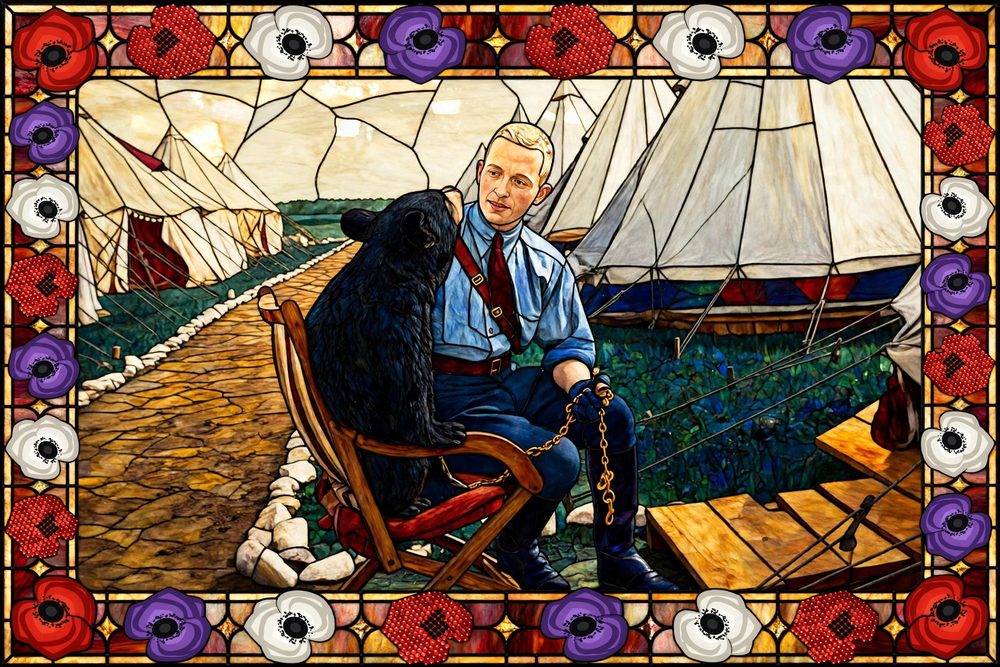
A Canadian veterinary officer, Lt. Harry Colebourn, sits with the bear cub he bought for $20 at White River, Ontario, and named Winnipeg — Winnie. Left at the London Zoo when he went to France, she became the bear Christopher Robin Milne loved — the real Winnie behind Winnie-the-Pooh.Un officier vétérinaire canadien, le lieutenant Harry Colebourn, pose avec l’oursonne qu’il a achetée 20 $ à White River, en Ontario, et nommée Winnipeg — Winnie. Laissée au zoo de Londres quand il est parti pour la France, elle est devenue l’ourse que Christopher Robin Milne adorait — la vraie Winnie derrière Winnie l’ourson.
Horace Brown fonds / Library and Archives Canada / Item 4386228Fonds Horace Brown / Bibliothèque et Archives Canada / pièce 4386228
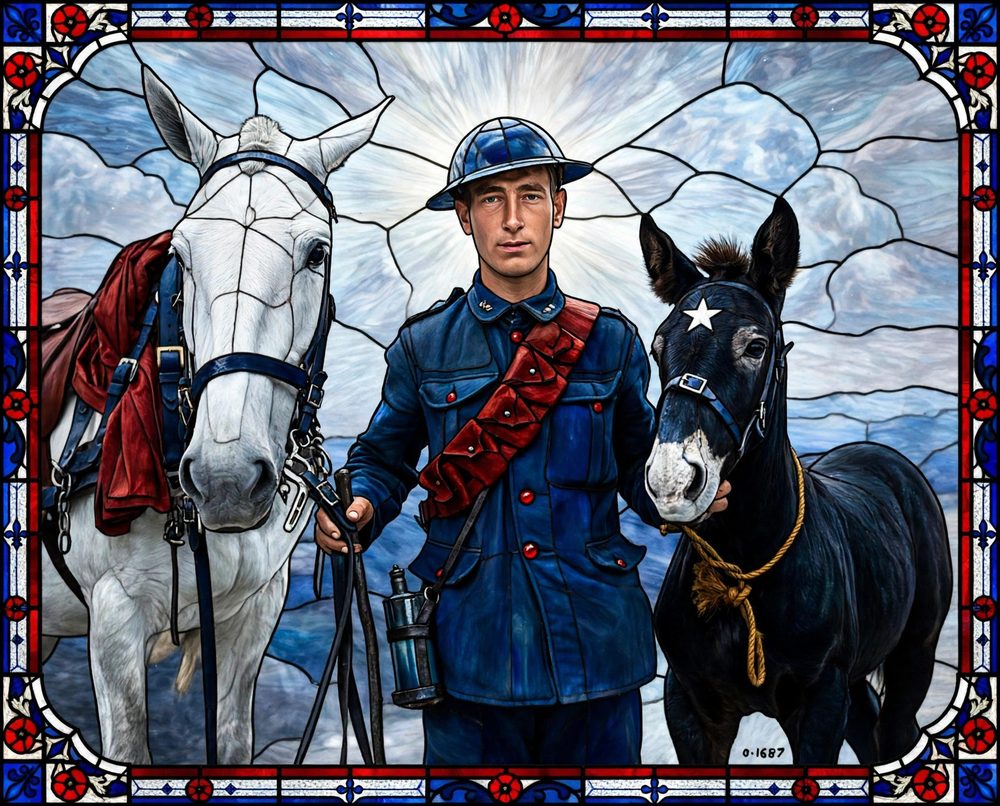
A gunner of the 20th Battery stands with a mare and her foal. The foal was born on Vimy Ridge during the battle in April 1917, and the gunners named her "Vimy."Un canonnier de la 20e Batterie se tient entre une jument et son poulain. Le poulain est né sur la crête de Vimy pendant la bataille d’avril 1917, et les canonniers l’ont nommé « Vimy ».
Canada. Dept. of National Defence / Library and Archives Canada / PA-001690Canada. Ministère de la Défense nationale / Bibliothèque et Archives Canada / PA-001690
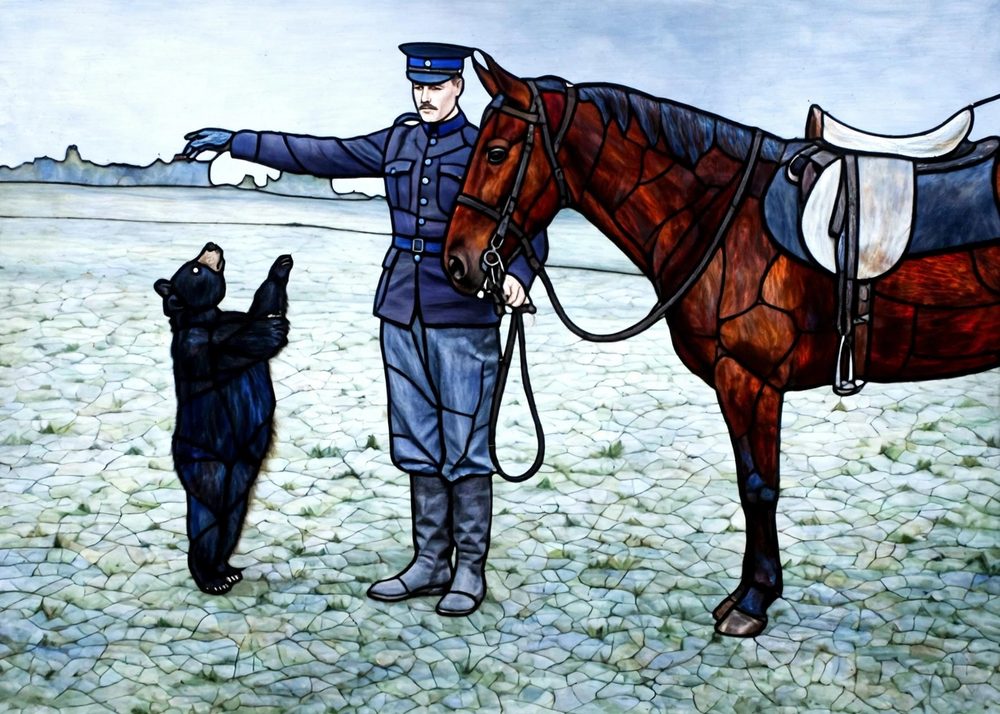
Winnie stands on her hind legs to reach a Canadian Army Veterinary Corps sergeant, who holds the reins of a saddled horse. She was a cavalry regiment's bear — the Fort Garry Horse — and horses were her world.Winnie se dresse sur ses pattes arrière pour atteindre un sergent du Corps vétérinaire de l’Armée canadienne, qui tient les rênes d’un cheval sellé. Elle était l’ourse d’un régiment de cavalerie — le Fort Garry Horse — et les chevaux étaient son monde.
Colebourn Family Archive, Toronto Metropolitan University (item page036a) / Wikimedia Commons (File:WinnieColebourn.jpg), public domainArchives de la famille Colebourn, Université métropolitaine de Toronto (pièce page036a) / Wikimedia Commons (fichier WinnieColebourn.jpg), domaine public
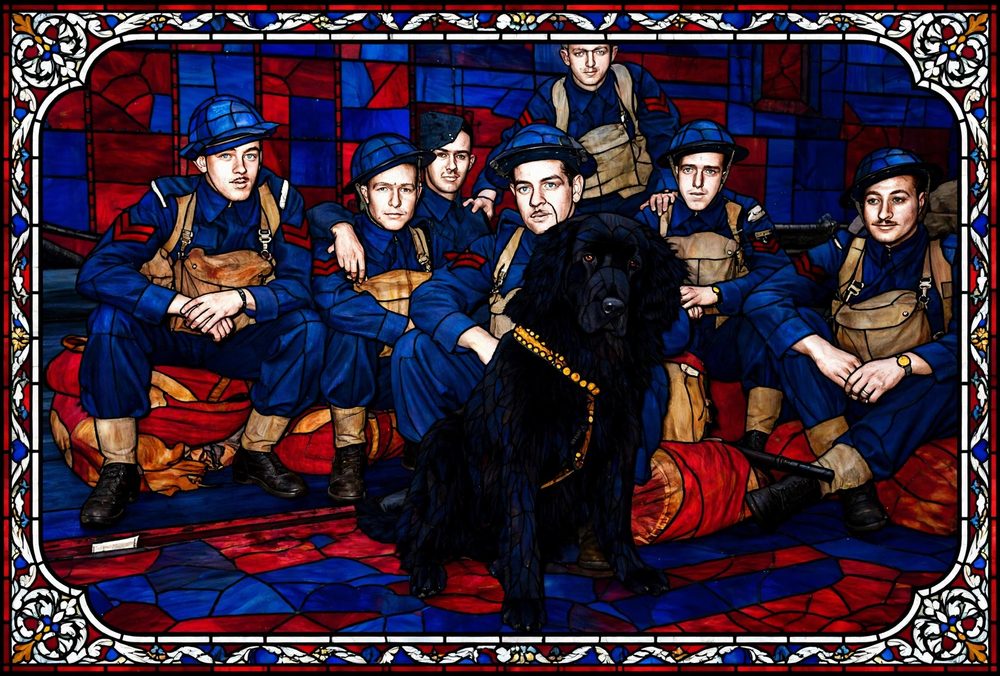
Gander, a Newfoundland dog, sits with the Royal Rifles of Canada as they sail for Hong Kong in October 1941. Weeks later, at Lye Mun, he picked up a live grenade that fell among wounded men and carried it away — saving at least seven lives, and losing his own. He received the Dickin Medal in 2000.Gander, un terre-neuve, pose avec les Royal Rifles of Canada en route vers Hong Kong, en octobre 1941. Quelques semaines plus tard, à Lye Mun, il a ramassé une grenade tombée parmi des blessés et l’a emportée au loin — sauvant au moins sept vies, et perdant la sienne. Il a reçu la médaille Dickin en 2000.
Canada. Dept. of National Defence / Library and Archives Canada / PA-116791Canada. Ministère de la Défense nationale / Bibliothèque et Archives Canada / PA-116791
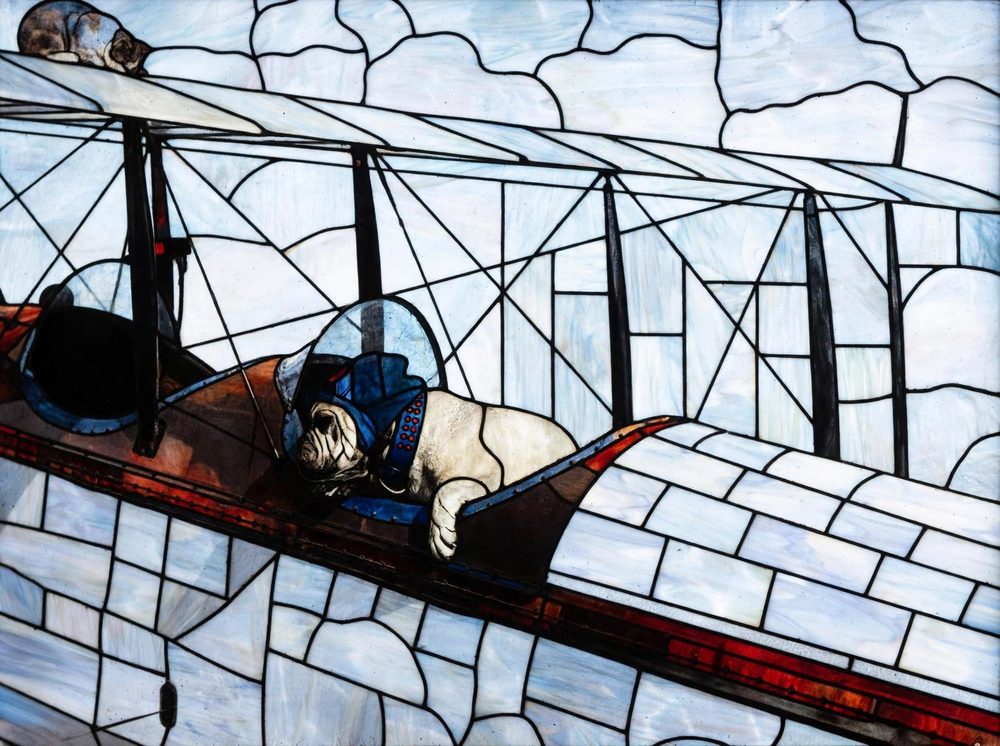
In the rear cockpit of a training biplane sits John Bull, the Royal Flying Corps camp bulldog, in flying helmet and goggles. Perched on the upper wing, entirely unbothered, is the camp cat.Dans le siège arrière d’un biplan d’entraînement trône John Bull, le bouledogue du camp du Royal Flying Corps, casque et lunettes de vol sur la tête. Perché sur l’aile supérieure, parfaitement indifférent, le chat du camp.
Deseronto Archives / Flickr Commons — no known copyright restrictionsArchives de Deseronto / Flickr Commons — aucune restriction de droit d’auteur connue
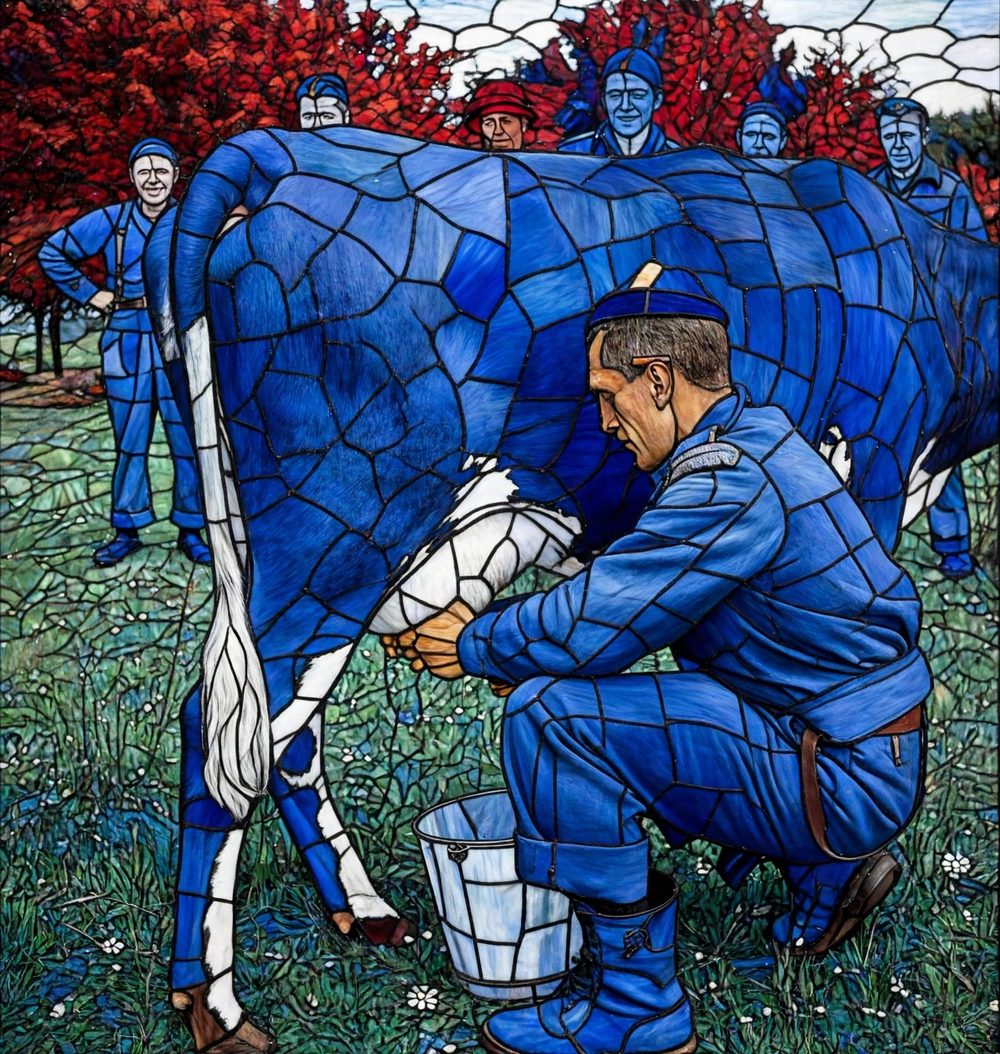
Rosie the cow was trapped between the German and Canadian lines, unmilked and in distress — until Private Lane of the Highland Light Infantry of Canada went out and milked her. The Army's own caption gives her name.Rosie la vache était coincée entre les lignes allemandes et canadiennes, pleine de lait et en détresse — jusqu’à ce que le soldat Lane, du Highland Light Infantry of Canada, aille la traire. La légende de l’Armée lui donne son nom.
Photo by Lieut. Ken Bell / Library and Archives Canada / PA-136845Photo : lieutenant Ken Bell / Bibliothèque et Archives Canada / PA-136845
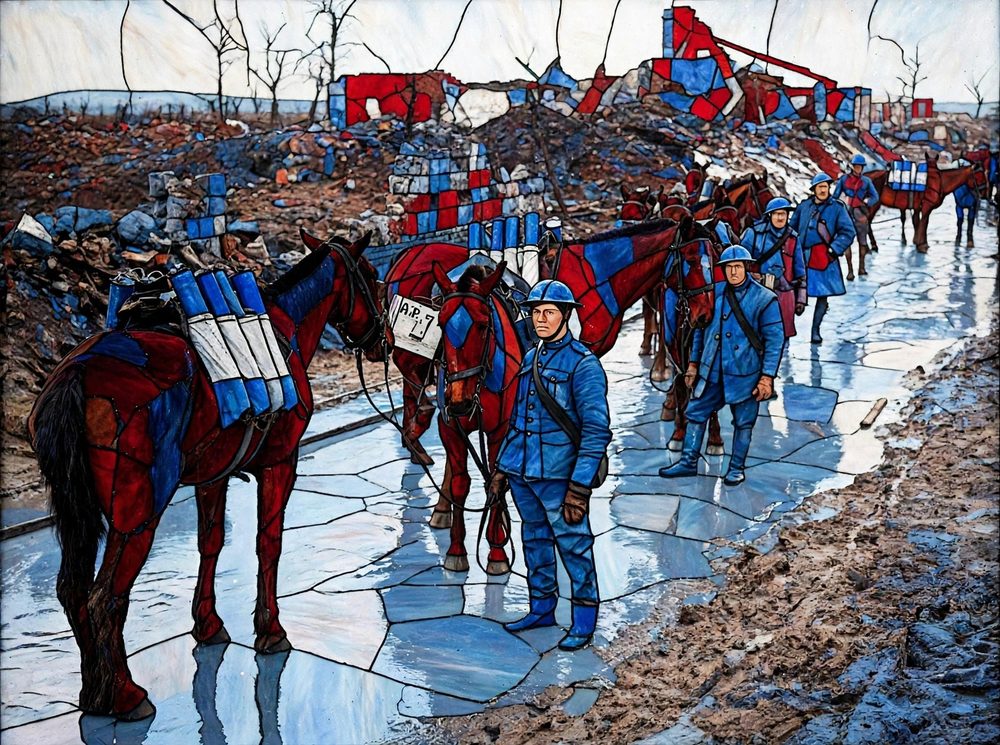
Pack horses carry shells up to the guns of the 20th Battery during the Battle of Vimy Ridge. The horses kept the guns firing — and the 1st Canadian Division alone lost some 600 of them at Vimy.Des chevaux de bât transportent des obus jusqu’aux canons de la 20e Batterie pendant la bataille de la crête de Vimy. Les chevaux gardaient les canons en action — et la 1re Division canadienne, à elle seule, en a perdu quelque 600 à Vimy.
Photo by William Ivor Castle / Library and Archives Canada / PA-001231Photo : William Ivor Castle / Bibliothèque et Archives Canada / PA-001231
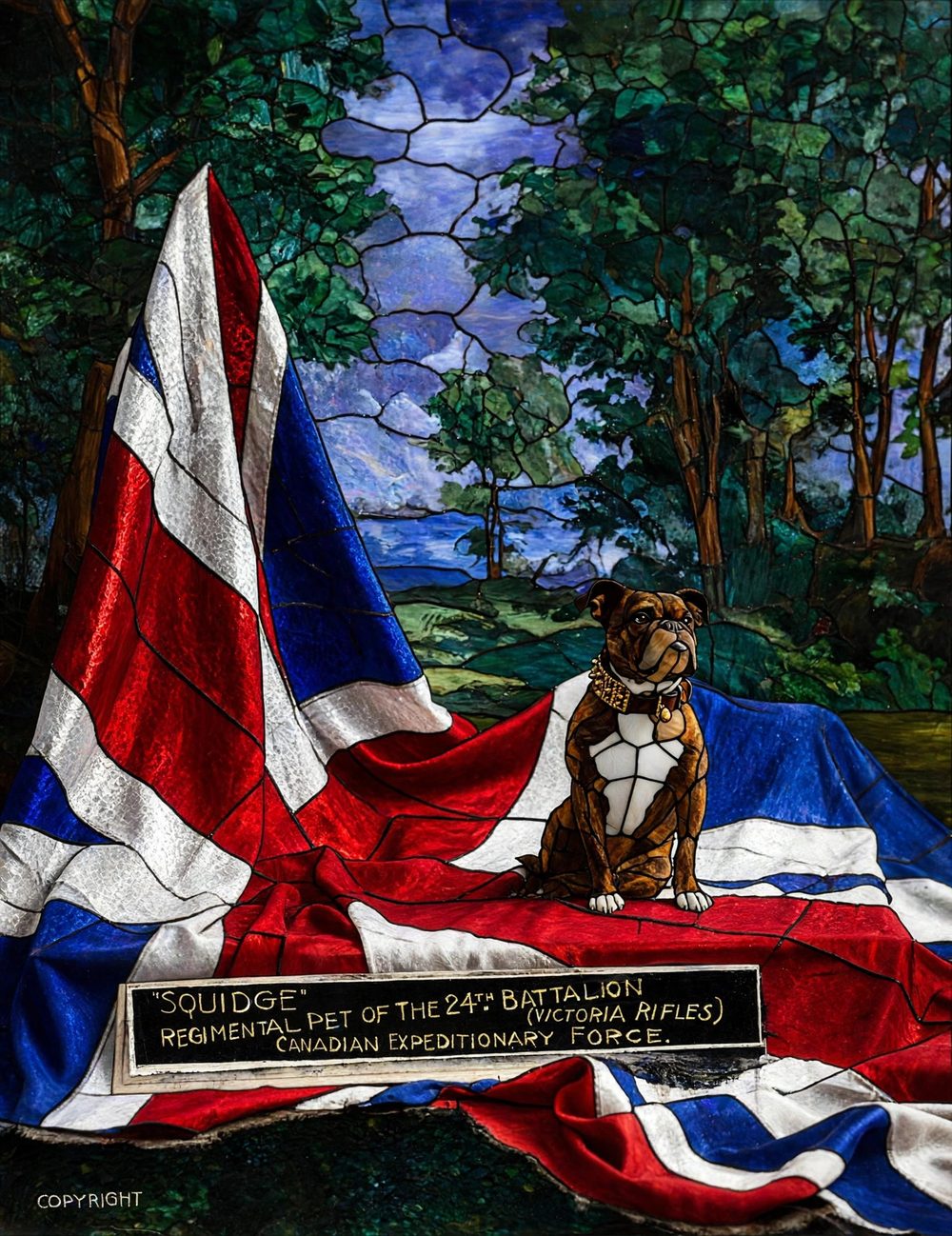
Before the 24th Battalion (Victoria Rifles of Canada) sailed in 1915, its pet bulldog Squidge was given the full studio treatment — a draped Union Jack, a painted backdrop, and his own engraved caption. The battalion's smallest recruit, formally portrayed.Avant le départ du 24e Bataillon (Victoria Rifles of Canada) en 1915, son bouledogue Squidge a eu droit au portrait de studio complet — drapeau Union Jack, décor peint et sa propre plaque gravée. La plus petite recrue du bataillon, en portrait officiel.
Canada. Patent and Copyright Office / Library and Archives Canada / PA-030204Canada. Bureau des brevets et du droit d’auteur / Bibliothèque et Archives Canada / PA-030204
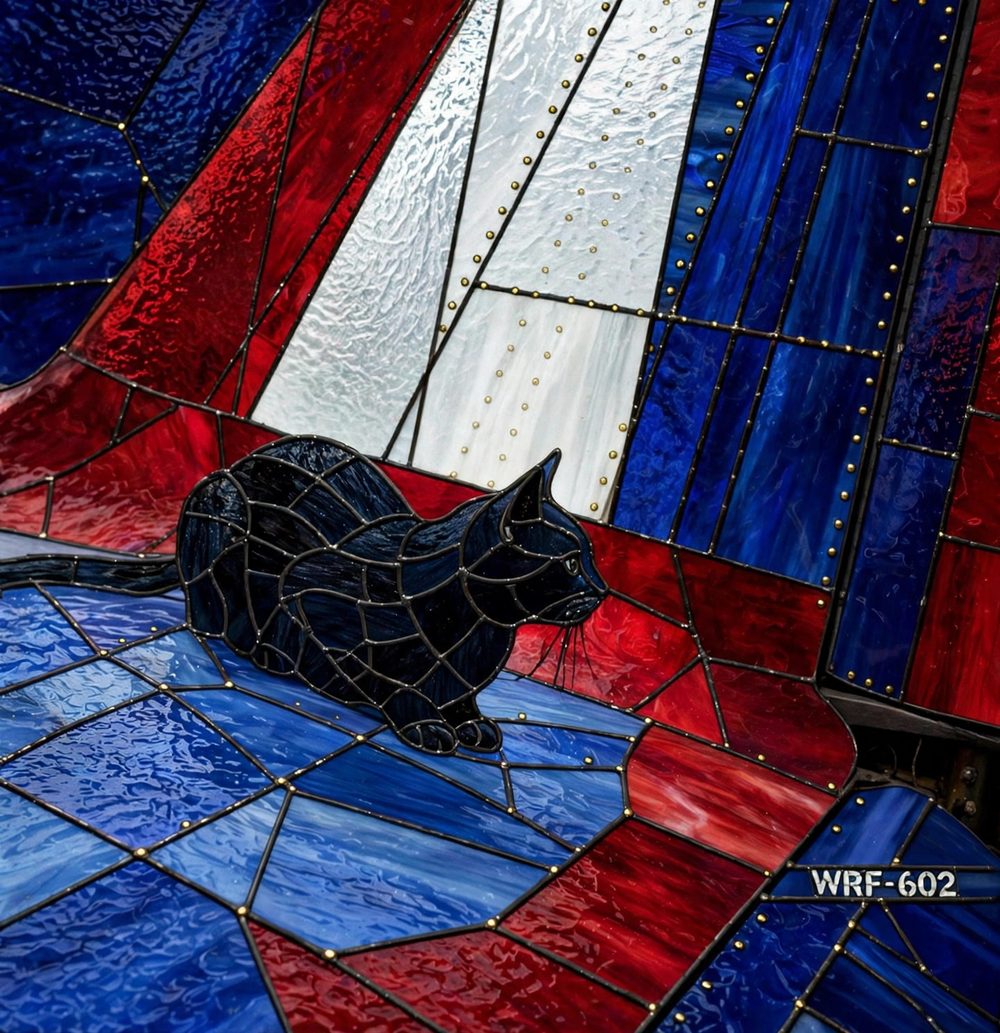
Ferry Command flew aircraft across the Atlantic to the war. At its Bermuda station in 1942, its mascot was a black cat, photographed on the wing by Nicholas Morant, one of Canada's great documentary photographers.Le Ferry Command convoyait des avions à travers l’Atlantique, vers la guerre. À sa station des Bermudes, en 1942, sa mascotte était un chat noir, photographié sur l’aile par Nicholas Morant, l’un des grands photographes documentaires du Canada.
Photo by Nicholas Morant / Library and Archives Canada / PA-166770Photo : Nicholas Morant / Bibliothèque et Archives Canada / PA-166770
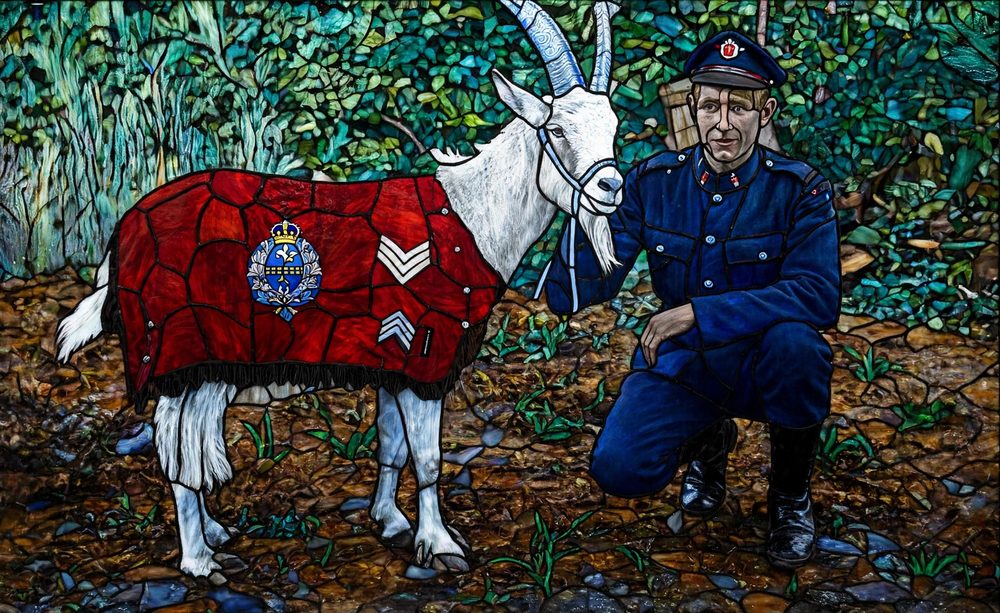
Sergeant Bill, a goat from Broadview, Saskatchewan, went overseas with the 5th Battalion, was wounded and gassed alongside the men, and — battalion legend holds — was once placed under arrest for eating military documents. He came home a sergeant.Le sergent Bill, une chèvre de Broadview, en Saskatchewan, est parti outre-mer avec le 5e Bataillon, a été blessé et gazé aux côtés des hommes et — selon la légende du bataillon — a même été mis aux arrêts pour avoir mangé des documents militaires. Il est revenu sergent.
Saskatchewan Archives Board R-A10210-1 / Wikimedia Commons, licence as stated on CommonsSaskatchewan Archives Board R-A10210-1 / Wikimedia Commons, licence telle qu’indiquée sur Commons
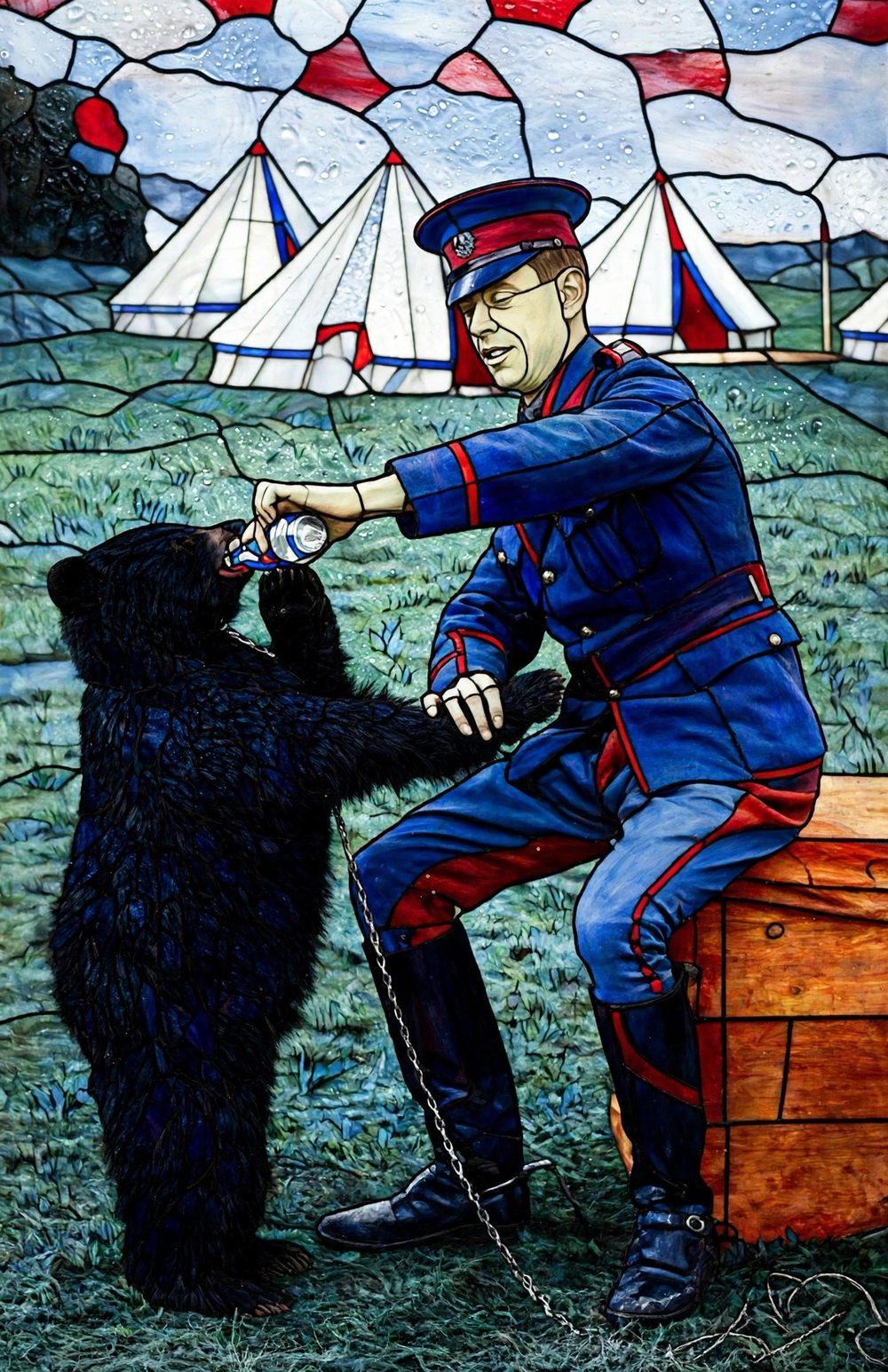
The photograph the world knows: Harry Colebourn seated on a crate, holding Winnie's paws as she stands to face him. Of all her portraits, this is the one that travelled — into the books, and into a century of childhoods.La photographie que le monde entier connaît : Harry Colebourn assis sur une caisse, tenant les pattes de Winnie dressée devant lui. De tous ses portraits, c’est celui qui a voyagé — dans les livres, et dans un siècle d’enfances.
Archives of Manitoba N10467 / Wikimedia Commons, licence as stated on CommonsArchives du Manitoba N10467 / Wikimedia Commons, licence telle qu’indiquée sur Commons
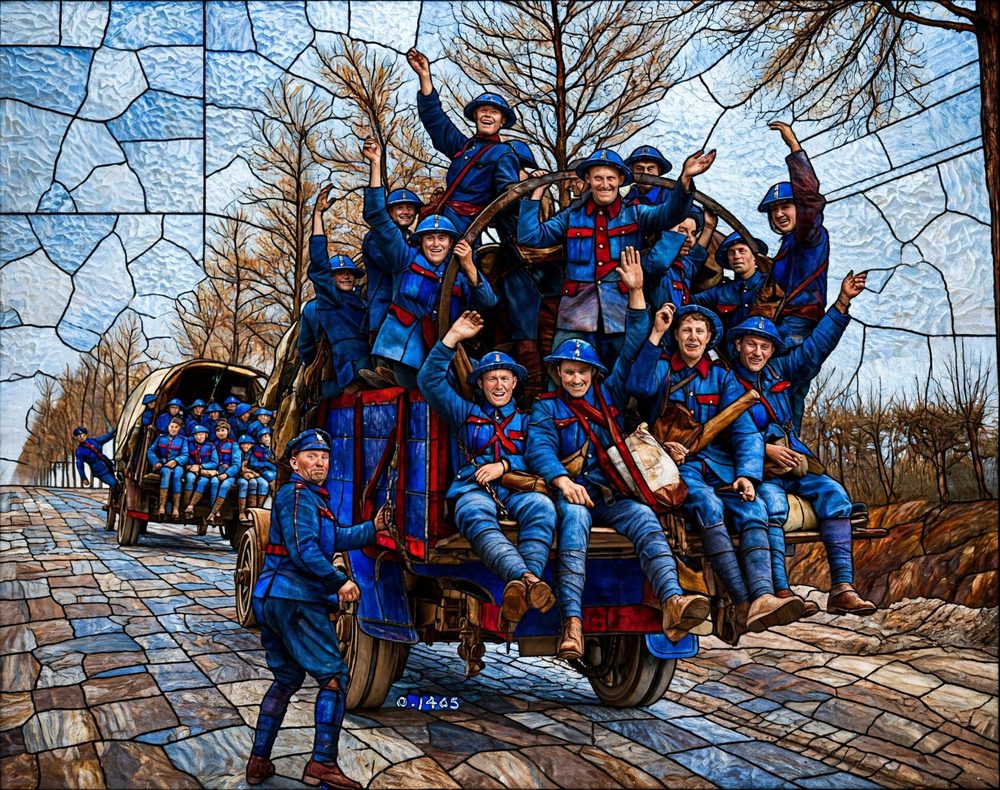
Canadian soldiers ride back from Vimy Ridge, cheering through the mud. They had taken the ridge — and they were still here to grin about it.Des soldats canadiens reviennent de la crête de Vimy, en riant à travers la boue. Ils avaient pris la crête — et ils étaient encore là pour en sourire.
Photo by William Ivor Castle / Library and Archives Canada / PA-001332Photo : William Ivor Castle / Bibliothèque et Archives Canada / PA-001332
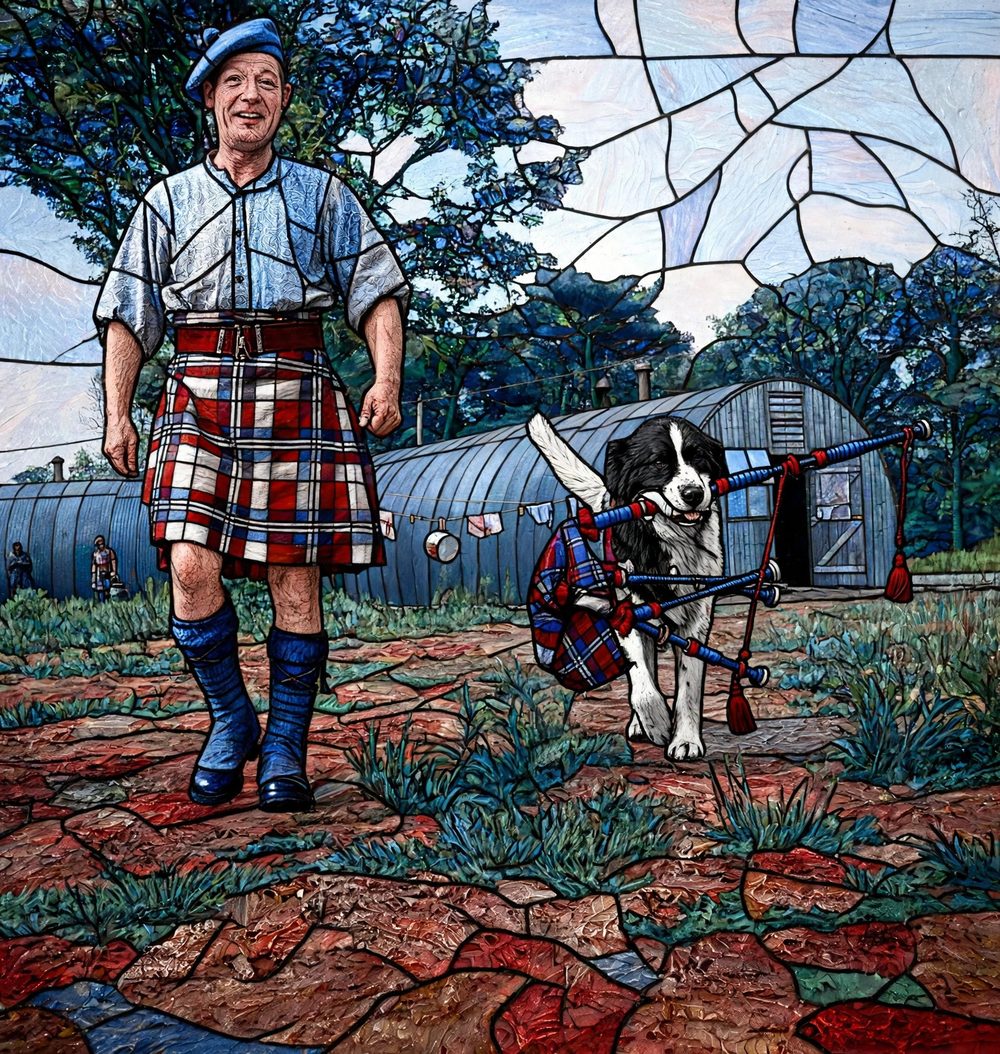
Wallace, mascot of the Canadian Scottish Regiment, didn't just pose with the bagpipes — he carried them, in his own tartan coat, beside the piper at the regiment's camp in England.Wallace, mascotte du Canadian Scottish Regiment, ne faisait pas que poser avec la cornemuse — il la portait, dans son propre manteau de tartan, aux côtés du joueur de cornemuse au camp du régiment en Angleterre.
Photo by Lieut. Alex M. Stirton / Library and Archives Canada / PA-130779Photo : lieutenant Alex M. Stirton / Bibliothèque et Archives Canada / PA-130779
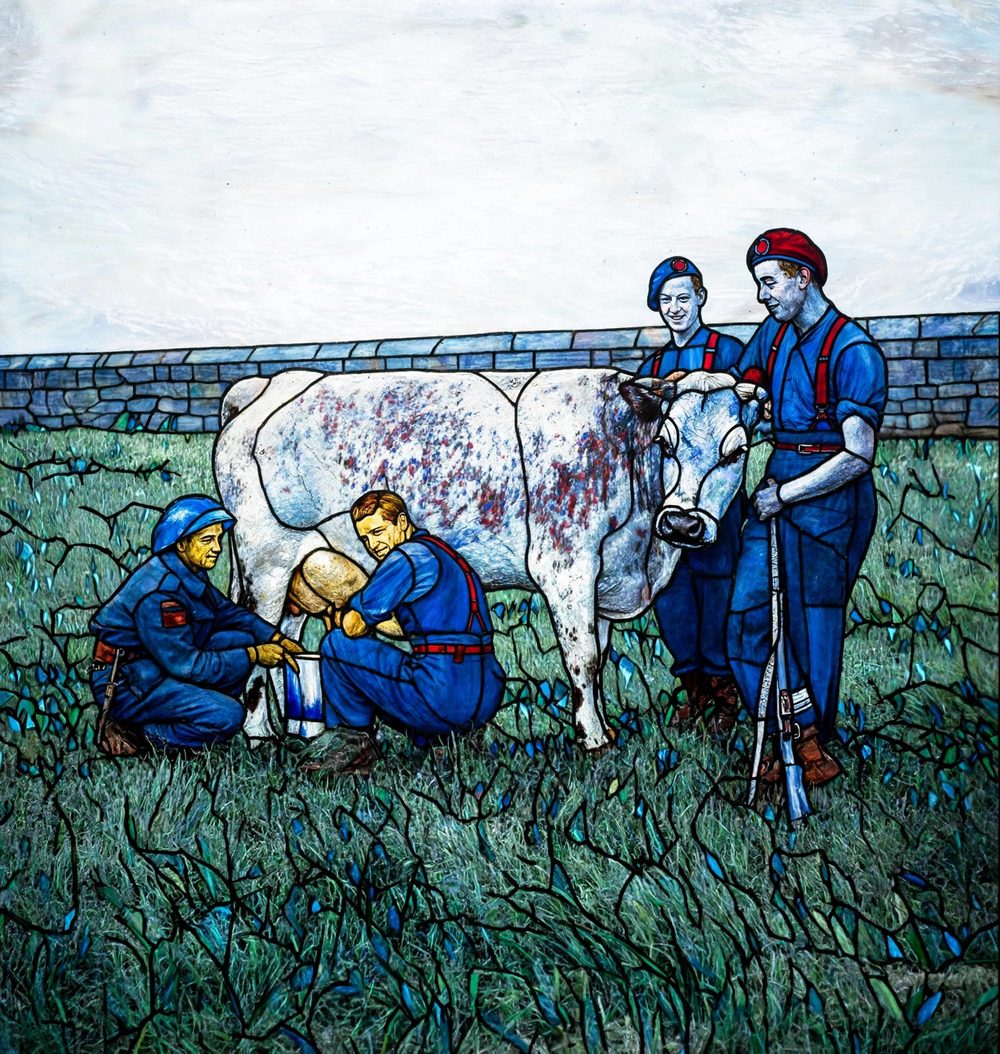
Four riflemen of the Queen's Own Rifles of Canada — Brueyere, Briere, Simpson and Payne — with the cow their unit milked every day, two weeks after D-Day. Fresh milk: a small act of normal life in the bridgehead.Quatre carabiniers des Queen’s Own Rifles of Canada — Brueyere, Briere, Simpson et Payne — avec la vache que leur unité trayait chaque jour, deux semaines après le jour J. Du lait frais : un petit acte de vie normale dans la tête de pont.
Photo by Lieut. Frank L. Dubervill / Library and Archives Canada / PA-190901Photo : lieutenant Frank L. Dubervill / Bibliothèque et Archives Canada / PA-190901
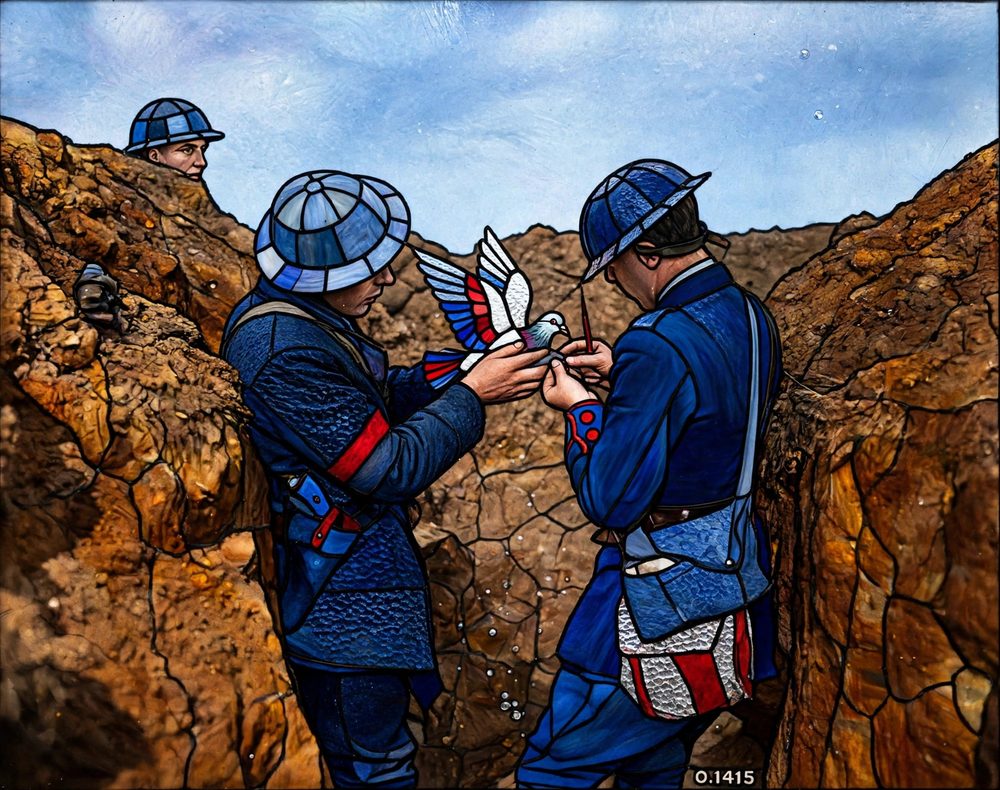
When shellfire cut the telephone wires — which was constantly — the Canadian Corps spoke to its guns by pigeon. A signaller fastens the message capsule to the bird before release.Quand les obus coupaient les fils téléphoniques — c’est-à-dire tout le temps — le Corps canadien parlait à ses canons par pigeon. Un signaleur attache la capsule du message à l’oiseau avant l’envol.
Photo by William Ivor Castle / Library and Archives Canada / PA-001275Photo : William Ivor Castle / Bibliothèque et Archives Canada / PA-001275
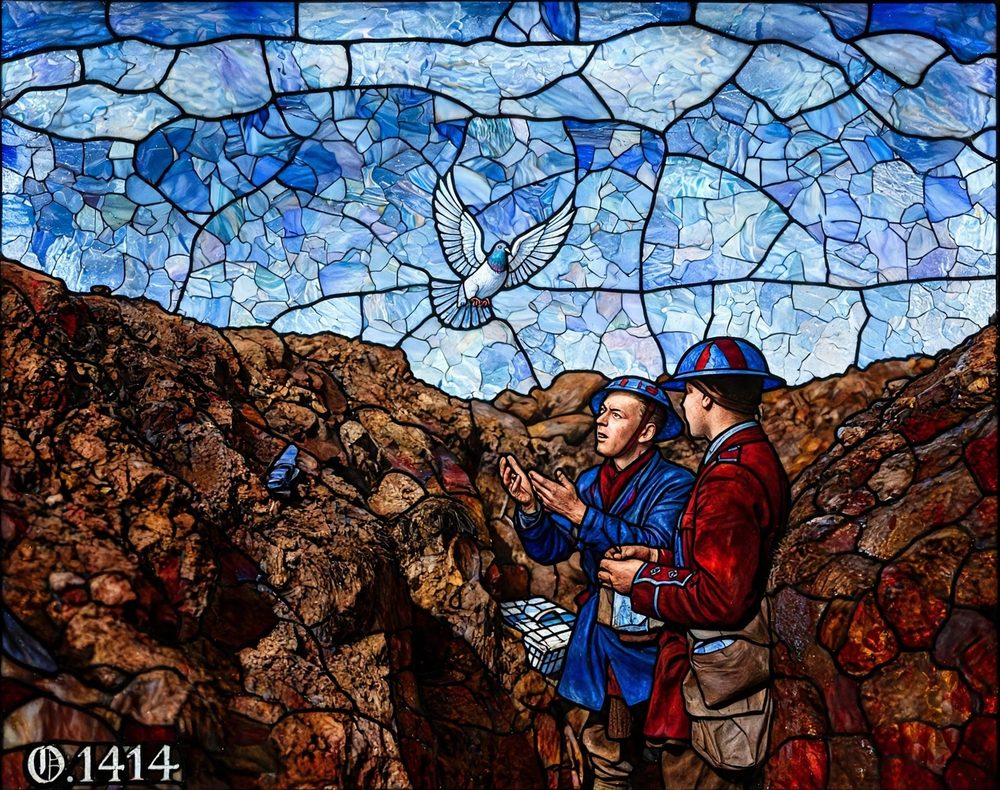
The moment of release: the pigeon leaves the trench with its message, flying back over the shellfire to the loft.Le moment de l’envol : le pigeon quitte la tranchée avec son message, et repart au-dessus des obus vers son colombier.
Photo by William Ivor Castle / Library and Archives Canada / PA-001378Photo : William Ivor Castle / Bibliothèque et Archives Canada / PA-001378
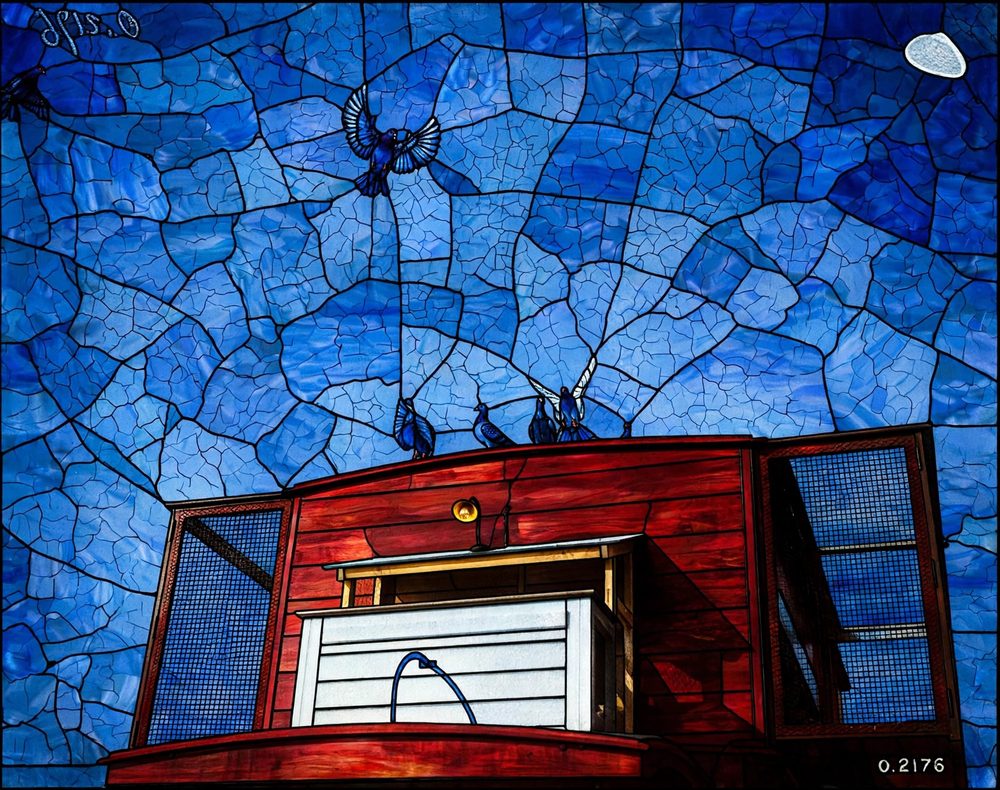
Pigeons arriving back at the loft with their messages from the trenches — the Corps' mail, delivered on wings.Les pigeons reviennent au colombier avec leurs messages des tranchées — le courrier du Corps, livré sur des ailes.
Photo by William Rider-Rider / Library and Archives Canada / PA-002074Photo : William Rider-Rider / Bibliothèque et Archives Canada / PA-002074
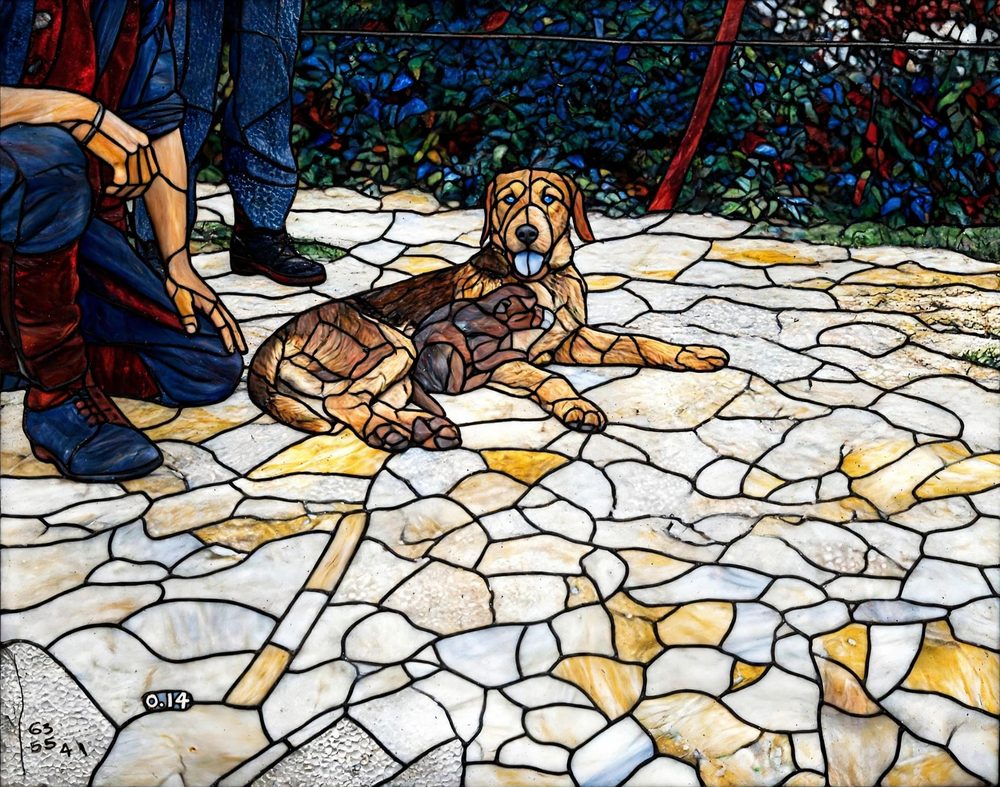
The 8th Battalion — Winnipeg's "Little Black Devils" — kept a trench hound at the front in 1916, photographed here between the soldiers' boots. The archive files her under Dogs and Monkeys both — the battalion kept both (see slide 25).Le 8e Bataillon — les « Little Black Devils » de Winnipeg — gardait une chienne de tranchée au front en 1916, photographiée ici entre les bottes des soldats. Les archives la classent sous Chiens et Singes à la fois — le bataillon gardait les deux (voir la diapositive 25).
Photo by Henry Edward Knobel / Library and Archives Canada / PA-000138Photo : Henry Edward Knobel / Bibliothèque et Archives Canada / PA-000138
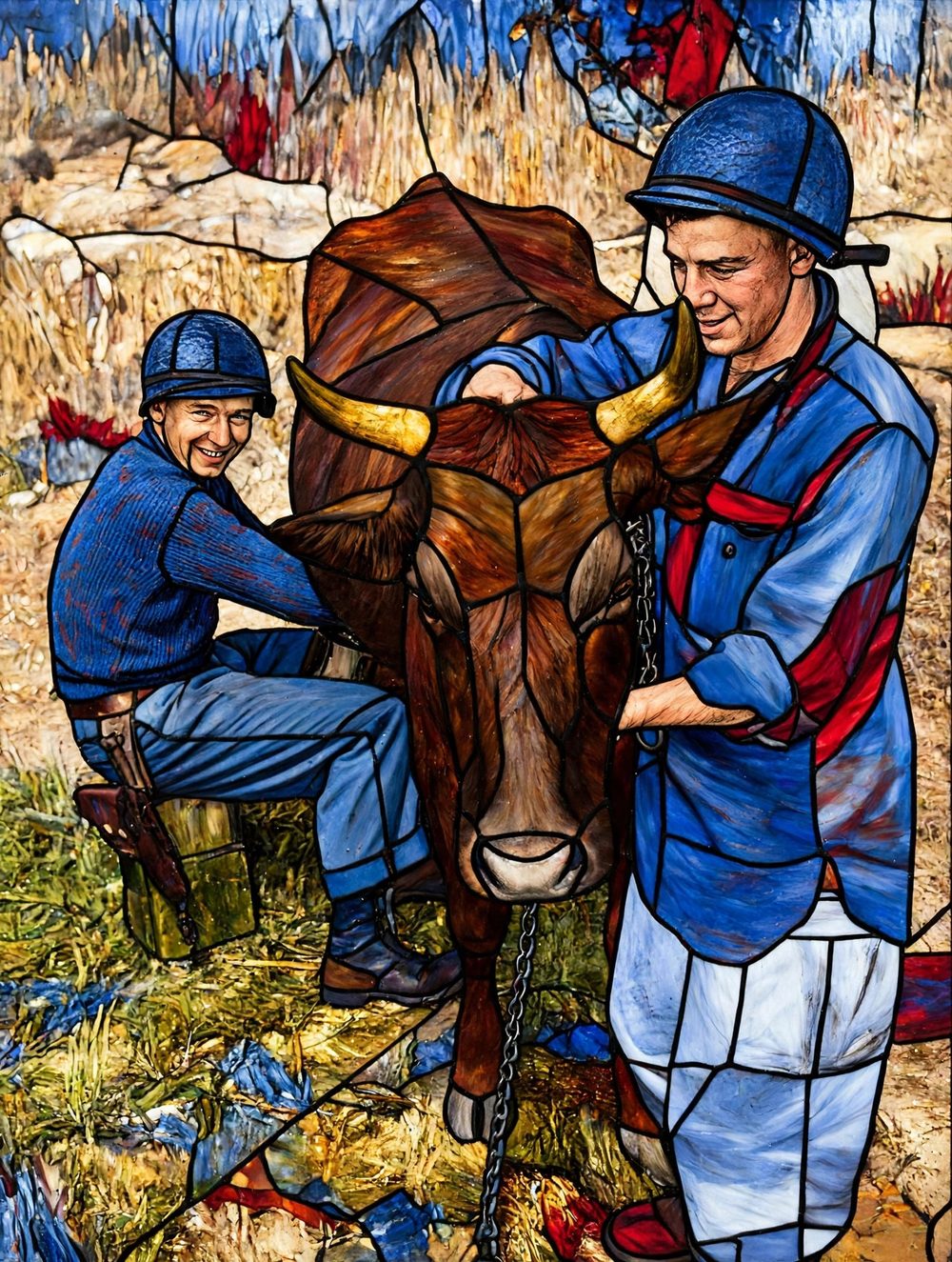
The First Special Service Force — the joint Canadian-American unit behind the "Devil's Brigade" legend — held a corner of the Anzio beachhead in April 1944, and even its Forcemen took a turn at the milking.La First Special Service Force — l’unité mixte canado-américaine derrière la légende de la « Devil’s Brigade » — tenait un coin de la tête de pont d’Anzio en avril 1944, et même ses Forcemen ont fait leur tour à la traite.
Photo by Lieut. C.E. Nye / Library and Archives Canada / PA-183729Photo : lieutenant C.E. Nye / Bibliothèque et Archives Canada / PA-183729
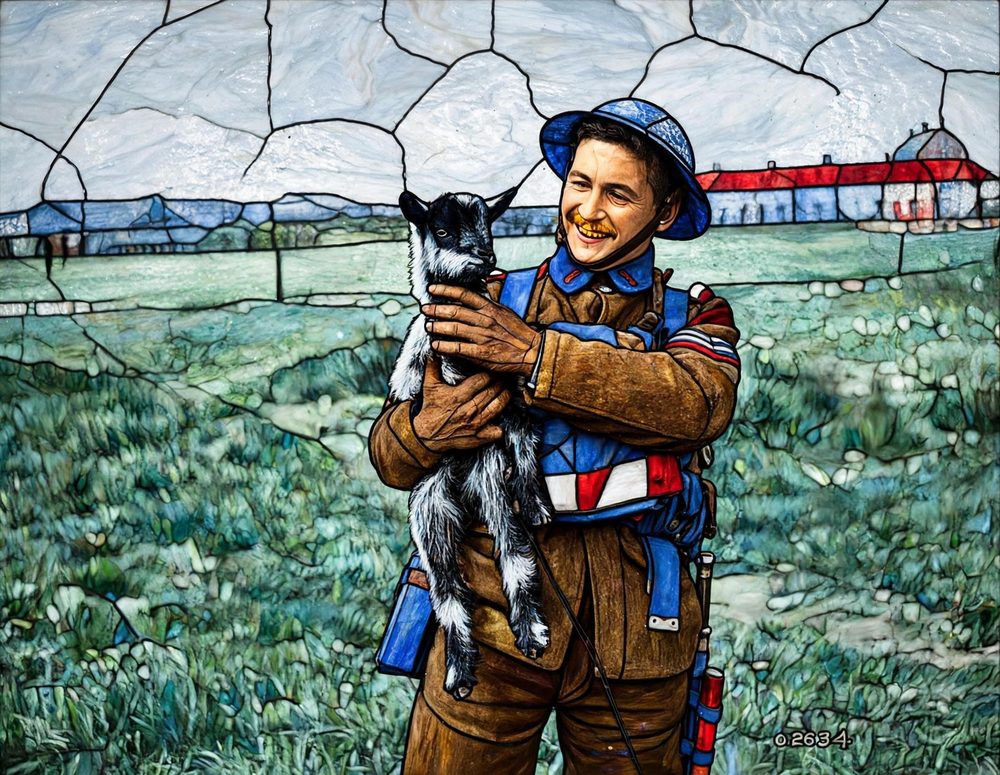
In May 1918 — three months before the Hundred Days — the 3rd Battalion (Toronto Regiment) paused for an official photograph of its smallest member, held in a sergeant's arms.En mai 1918 — trois mois avant les Cent Jours — le 3e Bataillon (Toronto Regiment) s’est arrêté pour une photo officielle de son plus petit membre, tenu dans les bras d’un sergent.
Canadian War Records Office / Library and Archives Canada / PA-002553Canadian War Records Office / Bibliothèque et Archives Canada / PA-002553
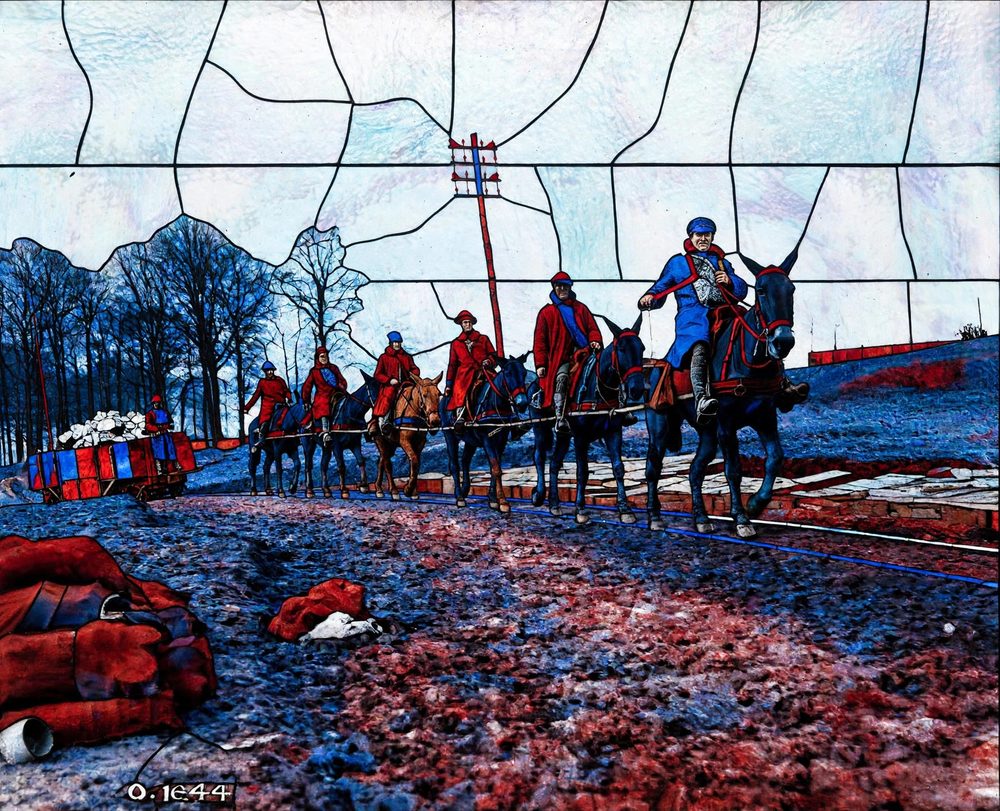
A mule team pulls a load of shells on a light railway near Petit Vimy, days after the attack. It was slow work, in the mud — and the guns depended on it.Un attelage de mulets tire un chargement d’obus sur un chemin de fer léger près de Petit Vimy, quelques jours après l’attaque. C’était un travail lent, dans la boue — et les canons en dépendaient.
Canadian War Records Office / Library and Archives Canada / PA-001135Canadian War Records Office / Bibliothèque et Archives Canada / PA-001135
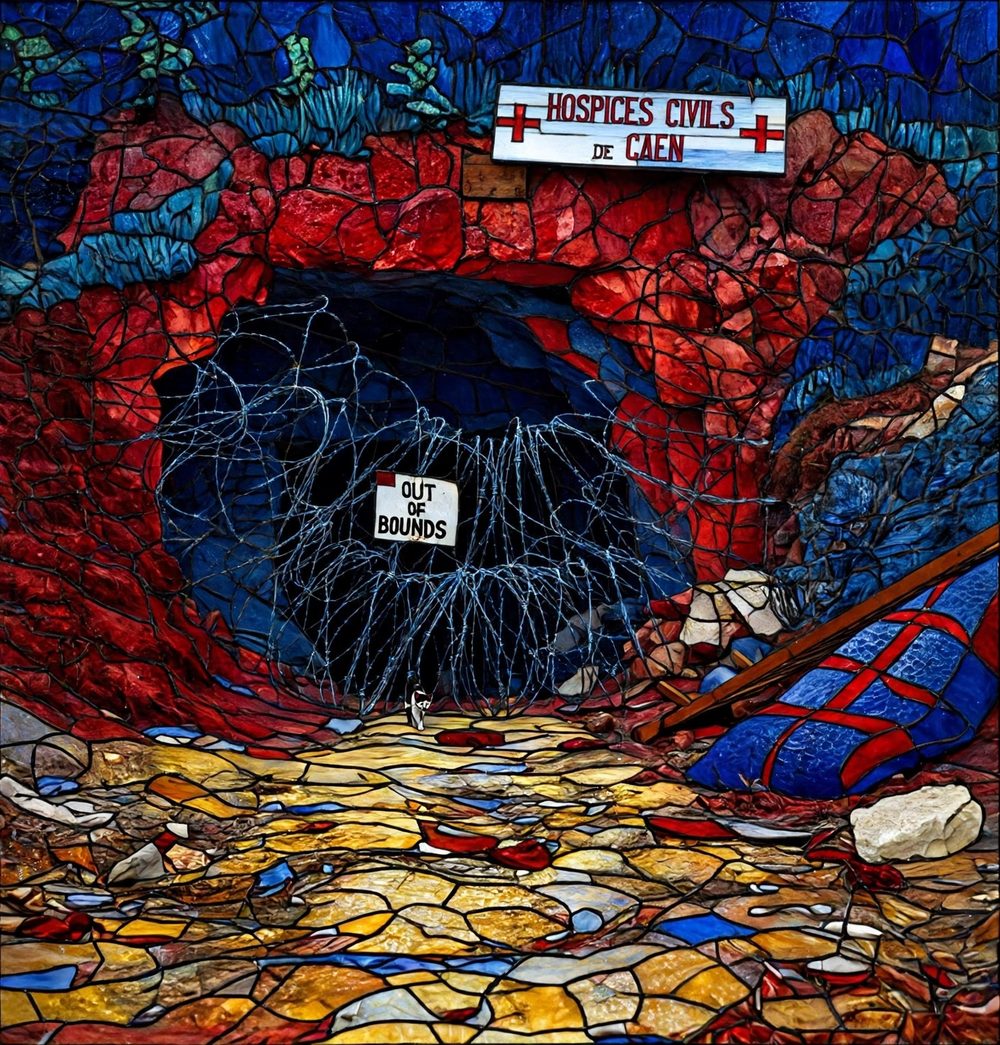
During the Battle of Caen, thousands of French civilians sheltered in the quarries and caves of Fleury-sur-Orne. A Canadian Army photographer recorded this one: a cat picking its way out of the shelter, looking — as the archive's own title says — for its master. The cat is small in the frame; the story is not.Pendant la bataille de Caen, des milliers de civils français se sont réfugiés dans les carrières et les grottes de Fleury-sur-Orne. Un photographe de l’Armée canadienne a saisi celle-ci : un chat qui sort de l’abri en cherchant — comme le dit le titre même des archives — son maître. Le chat est petit dans l’image; l’histoire ne l’est pas.
Photo by Lieut. Frank L. Dubervill / Library and Archives Canada / PA-130186Photo : lieutenant Frank L. Dubervill / Bibliothèque et Archives Canada / PA-130186
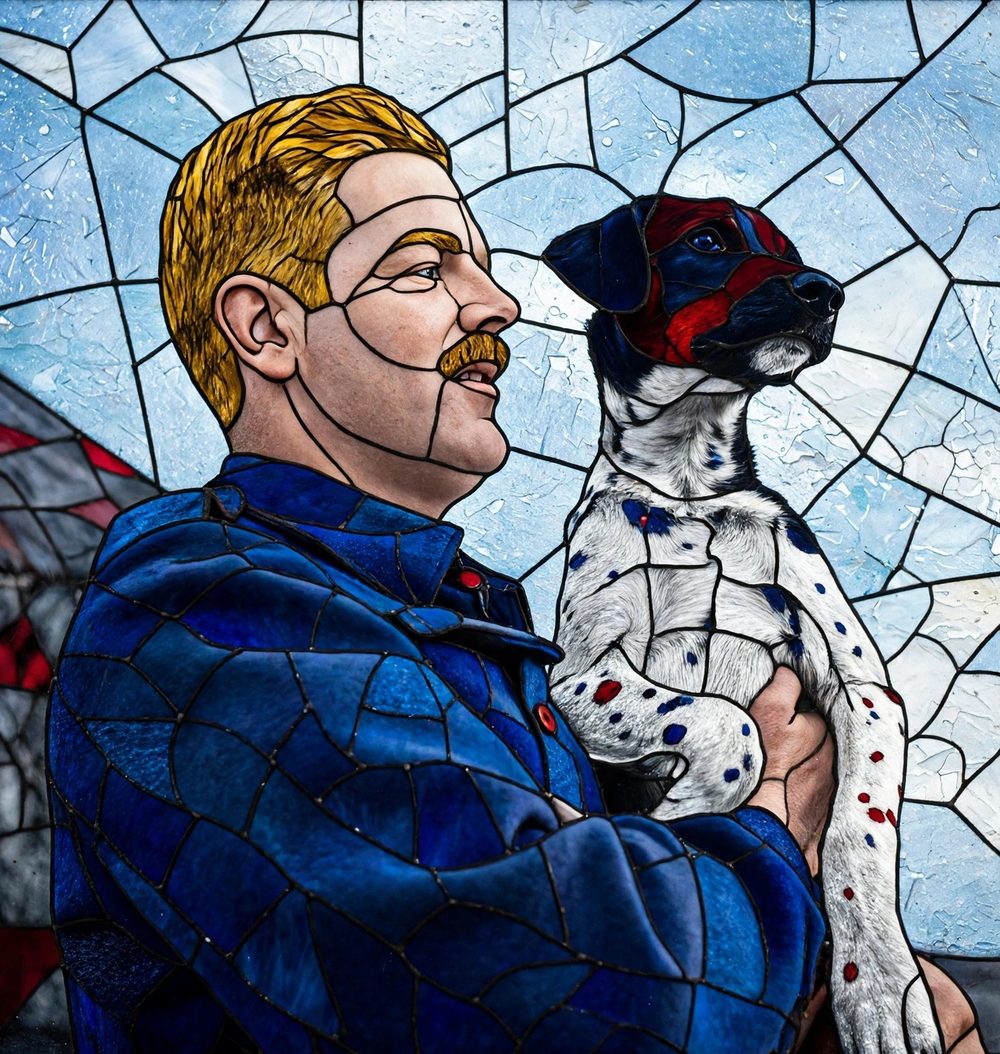
Even in the Scheldt fighting of October 1944, a field regiment of the Royal Canadian Artillery kept a mascot — Gunner Bracken holds Skippy — and the Army's own photographer thought him worth a frame.Même dans les combats de l’Escaut, en octobre 1944, un régiment d’artillerie de campagne gardait sa mascotte — l’artilleur Bracken tient Skippy — et le photographe de l’Armée a jugé qu’il valait une photo.
Photo by Lieut. Ken Bell / Library and Archives Canada / PA-143930Photo : lieutenant Ken Bell / Bibliothèque et Archives Canada / PA-143930
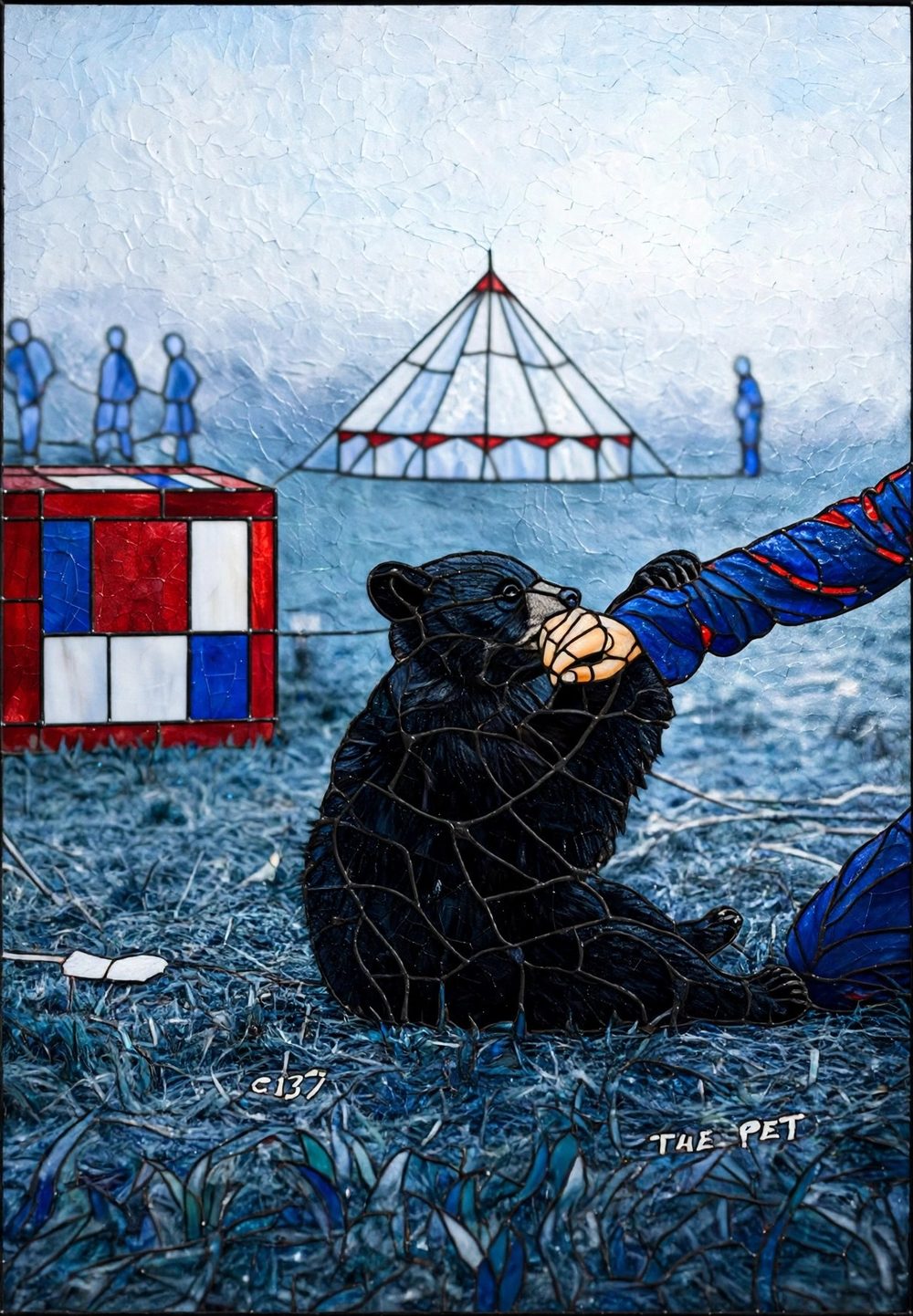
Winnie on the grass, playfully mouthing a soldier's sleeve — the original print is captioned by hand, in pencil: THE PET. A whole regiment's war, and she was its softest hour.Winnie sur l’herbe, mordillant en jouant la manche d’un soldat — sur l’épreuve originale, quelqu’un a écrit au crayon : THE PET. La guerre d’un régiment entier, et elle en était l’heure la plus douce.
Manitoba Archives, Colebourn Collection / Wikimedia Commons, licence as stated on CommonsArchives du Manitoba, collection Colebourn / Wikimedia Commons, licence telle qu’indiquée sur Commons
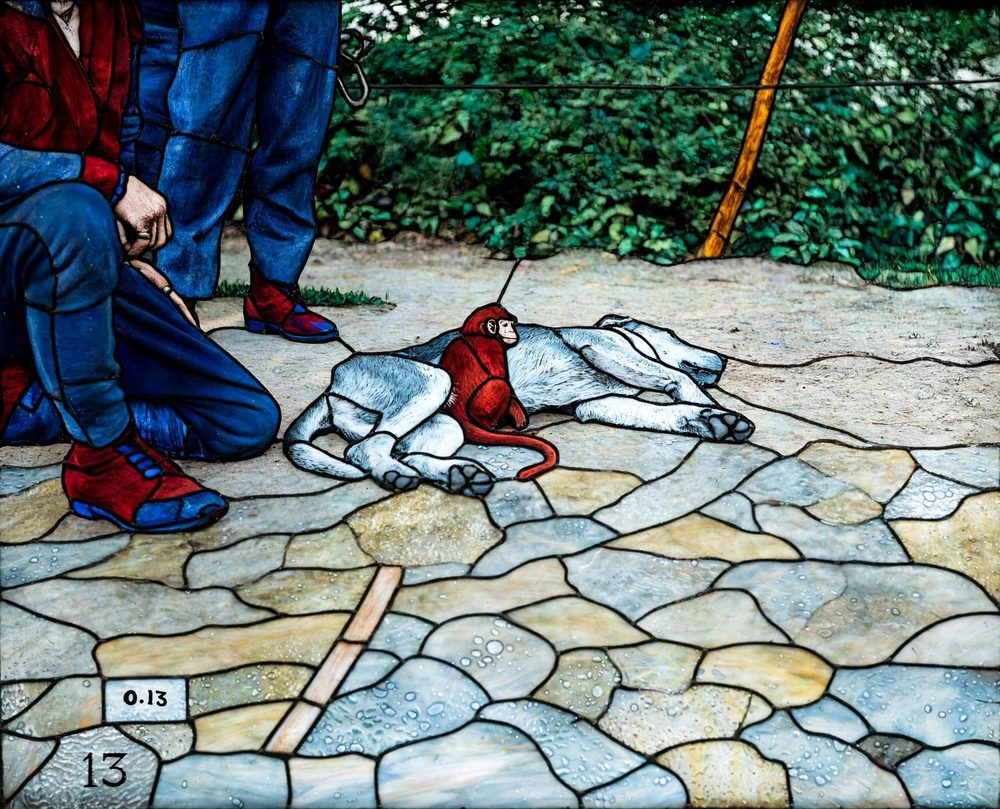
The 8th Battalion's trench hound asleep — and cuddled against her, the battalion's monkey. Two mascots, one nap, photographed by the trenches in May 1916. This is the frame just before slide 18.La chienne de tranchée du 8e Bataillon endormie — et blotti contre elle, le singe du bataillon. Deux mascottes, une sieste, photographiées près des tranchées en mai 1916. C’est l’image juste avant celle de la diapositive 18.
Sir Sandford Fleming collection / Library and Archives Canada / PA-000121Collection Sir Sandford Fleming / Bibliothèque et Archives Canada / PA-000121
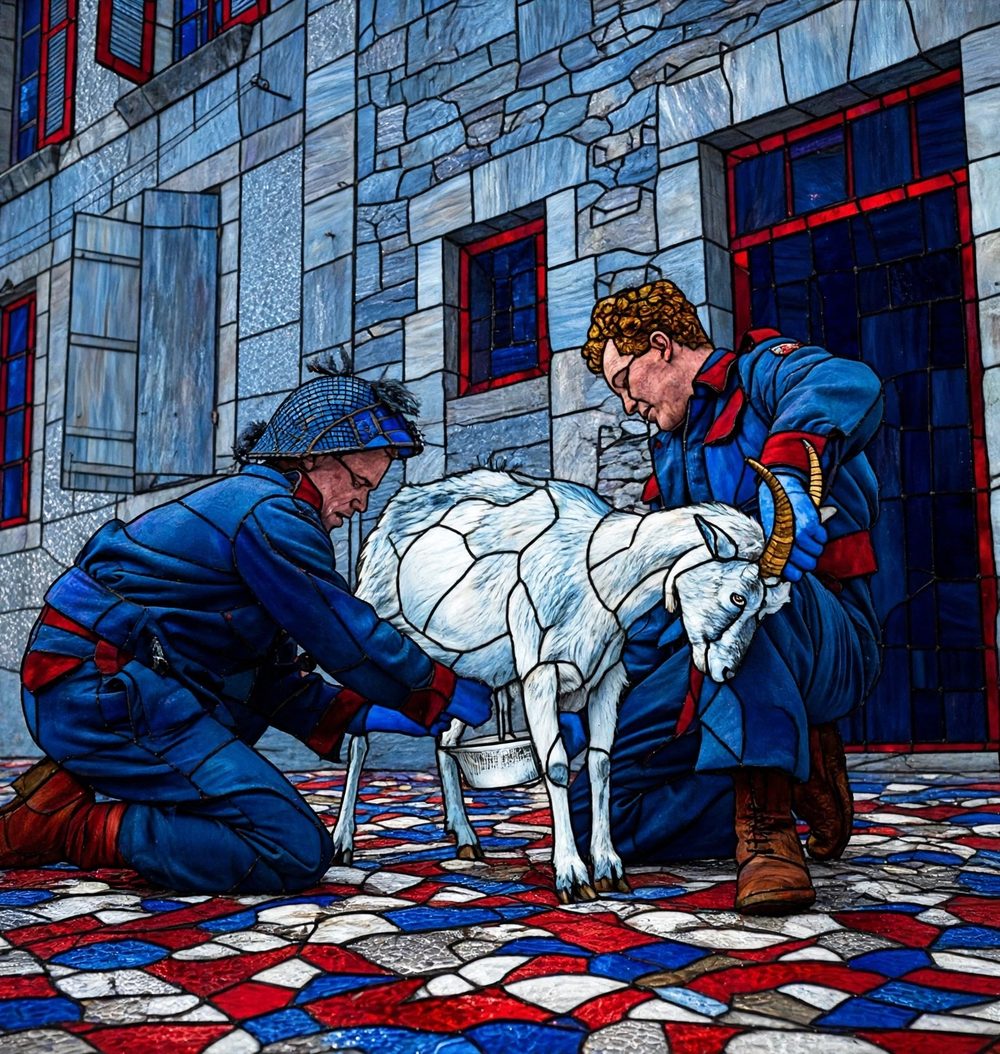
The same morning, the same photographer's camera found the Highland Light Infantry feeding itself off the Normandy countryside — a cow in one frame (slide 6), a goat in the next.Le même matin, l’appareil du même photographe a trouvé le Highland Light Infantry en train de se nourrir sur la campagne normande — une vache dans une image (diapositive 6), une chèvre dans la suivante.
Photo by Lieut. Ken Bell / Library and Archives Canada / PA-133117Photo : lieutenant Ken Bell / Bibliothèque et Archives Canada / PA-133117
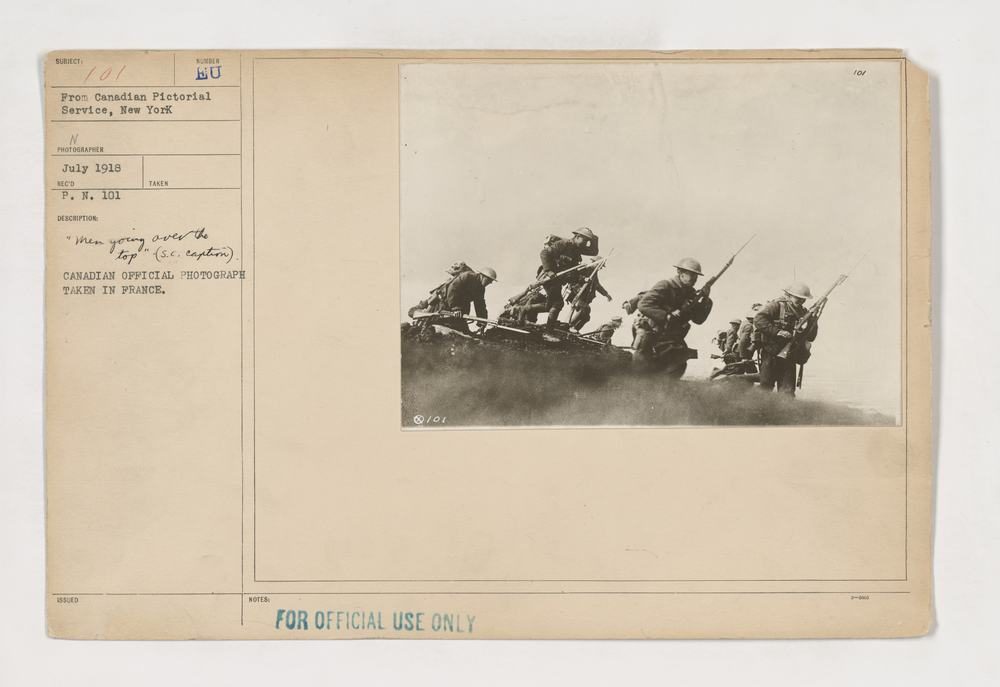
This famous photo was published as a battle scene in 1916. Years later, the archive found the truth: it shows a training exercise, with shell bursts added in. We show it with its real story.Cette photo célèbre a été publiée comme une scène de bataille en 1916. Des années plus tard, les archives ont trouvé la vérité : elle montre un exercice d’entraînement, avec des éclats d’obus ajoutés. Nous la montrons avec sa vraie histoire.
This one stays a photograph: the card is a document, and its text is the record.Celle-ci reste une photographie : la fiche est un document, et son texte est le dossier.
Photo by William Ivor Castle / U.S. National Archives (NARA) 55161625; also held by Library and Archives Canada as O-874Photo : William Ivor Castle / Archives nationales des États-Unis (NARA) 55161625; aussi conservée à Bibliothèque et Archives Canada sous la cote O-874
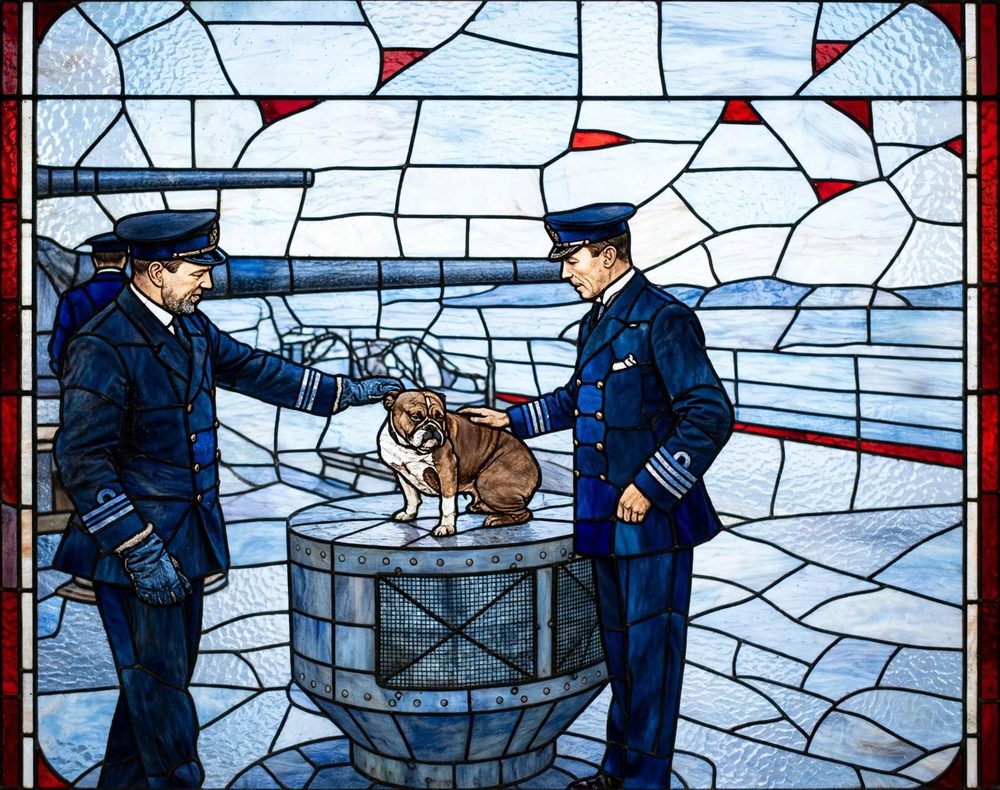
HMS Canada's bulldog mascot poses on deck beneath the 14-inch guns. The ship was Royal Navy — the Canadian link is the man behind the camera: William Ivor Castle, Canada's official photographer, took this for the Canadian War Records Office.Le bouledogue mascotte du HMS Canada pose sur le pont, sous les canons de 14 pouces. Le navire était de la Royal Navy — le lien canadien est l’homme derrière l’appareil : William Ivor Castle, photographe officiel du Canada, a pris cette photo pour le Canadian War Records Office.
Photo by William Ivor Castle / Library and Archives Canada / N-112Photo : William Ivor Castle / Bibliothèque et Archives Canada / N-112
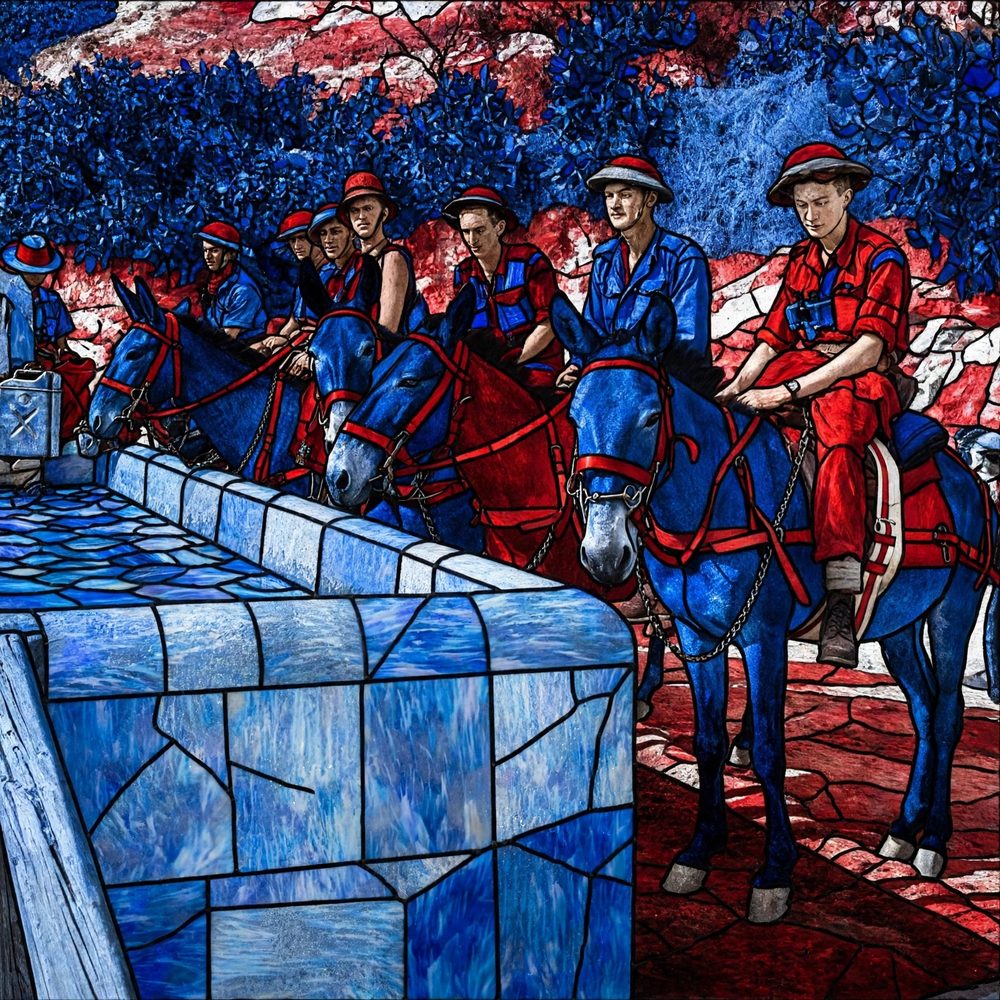
In Sicily's hills in 1943, Canadian infantry still moved on mule-power where trucks couldn't go — the Second World War echo of the Vimy mule team (slide 21).Dans les collines de Sicile, en 1943, l’infanterie canadienne avançait encore à dos de mulet là où les camions ne passaient pas — l’écho, une guerre plus tard, de l’attelage de Vimy (diapositive 21).
Photo by Lieut. Jack H. Smith / Library and Archives Canada / PA-129780Photo : lieutenant Jack H. Smith / Bibliothèque et Archives Canada / PA-129780
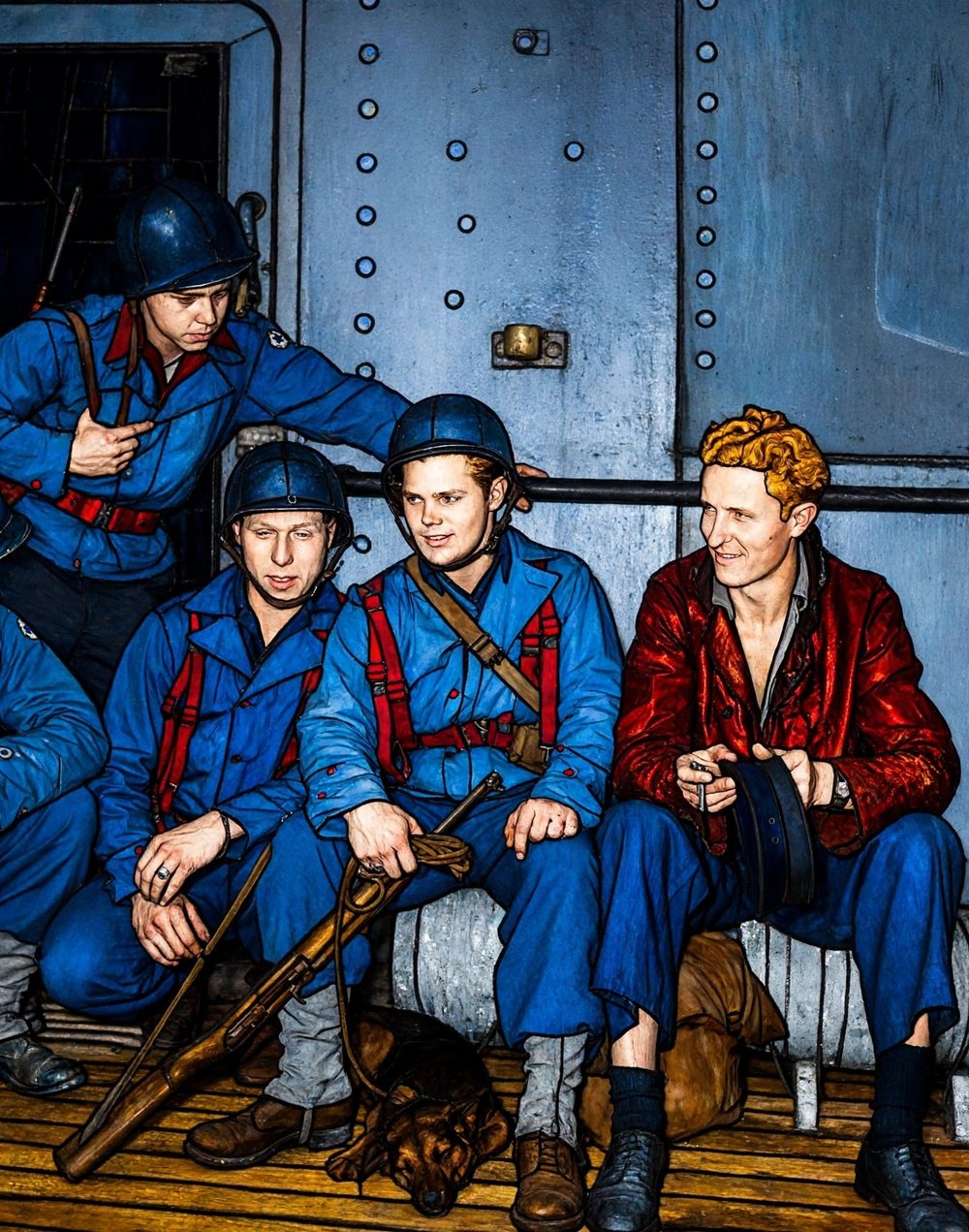
A month after D-Day, the Canadian landing ship HMCS Prince David was still working off Omaha Beach — with an American chemical company's mascot dog on deck, photographed with Canadian sailor Freddy Derkach.Un mois après le jour J, le navire de débarquement canadien NCSM Prince David travaillait encore au large d’Omaha Beach — avec, sur le pont, le chien mascotte d’une compagnie chimique américaine, photographié avec le matelot canadien Freddy Derkach.
Photo by PO Donovan J. Thorndick / Library and Archives Canada / PA-190831Photo : maître Donovan J. Thorndick / Bibliothèque et Archives Canada / PA-190831
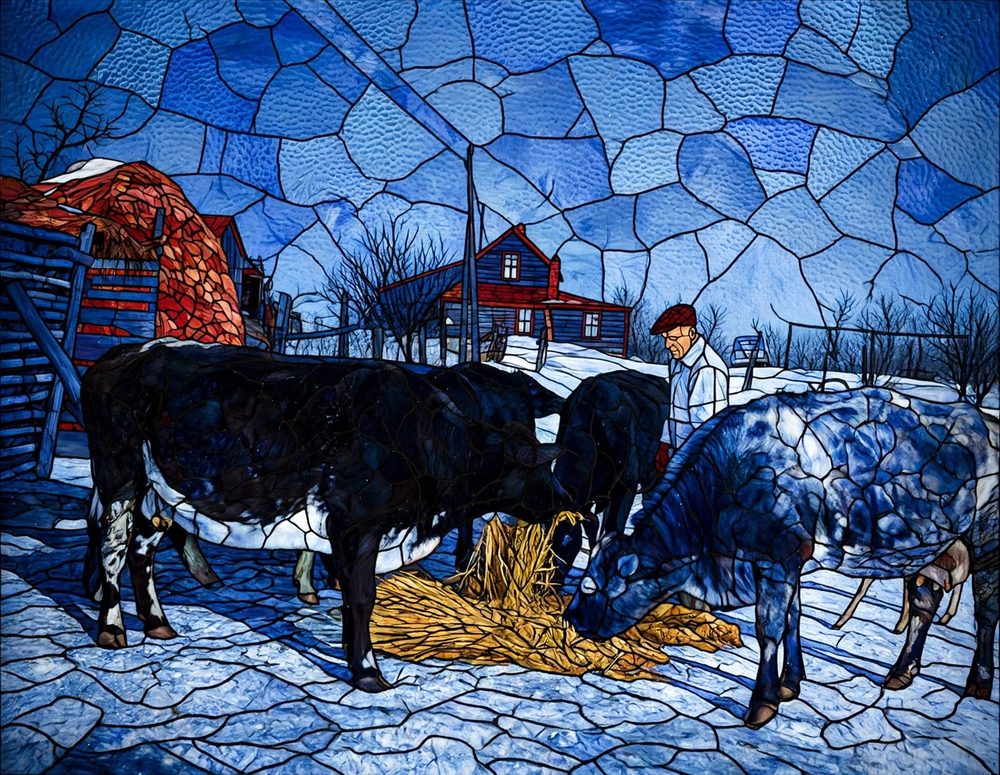
The cow story, continued past the fighting: under the Soldier Settlement scheme, former Canadian Army man George Cowan was farming north of Brandon, Manitoba, by March 1945 — and this herd is what he came home to build.L’histoire des vaches, après les combats : grâce au programme d’établissement des soldats, George Cowan, ancien militaire canadien, cultivait sa terre au nord de Brandon, au Manitoba, en mars 1945 — et ce troupeau est ce qu’il est revenu bâtir.
Photo by Jack Long, National Film Board of Canada / Library and Archives Canada / PA-144820Photo : Jack Long, Office national du film du Canada / Bibliothèque et Archives Canada / PA-144820
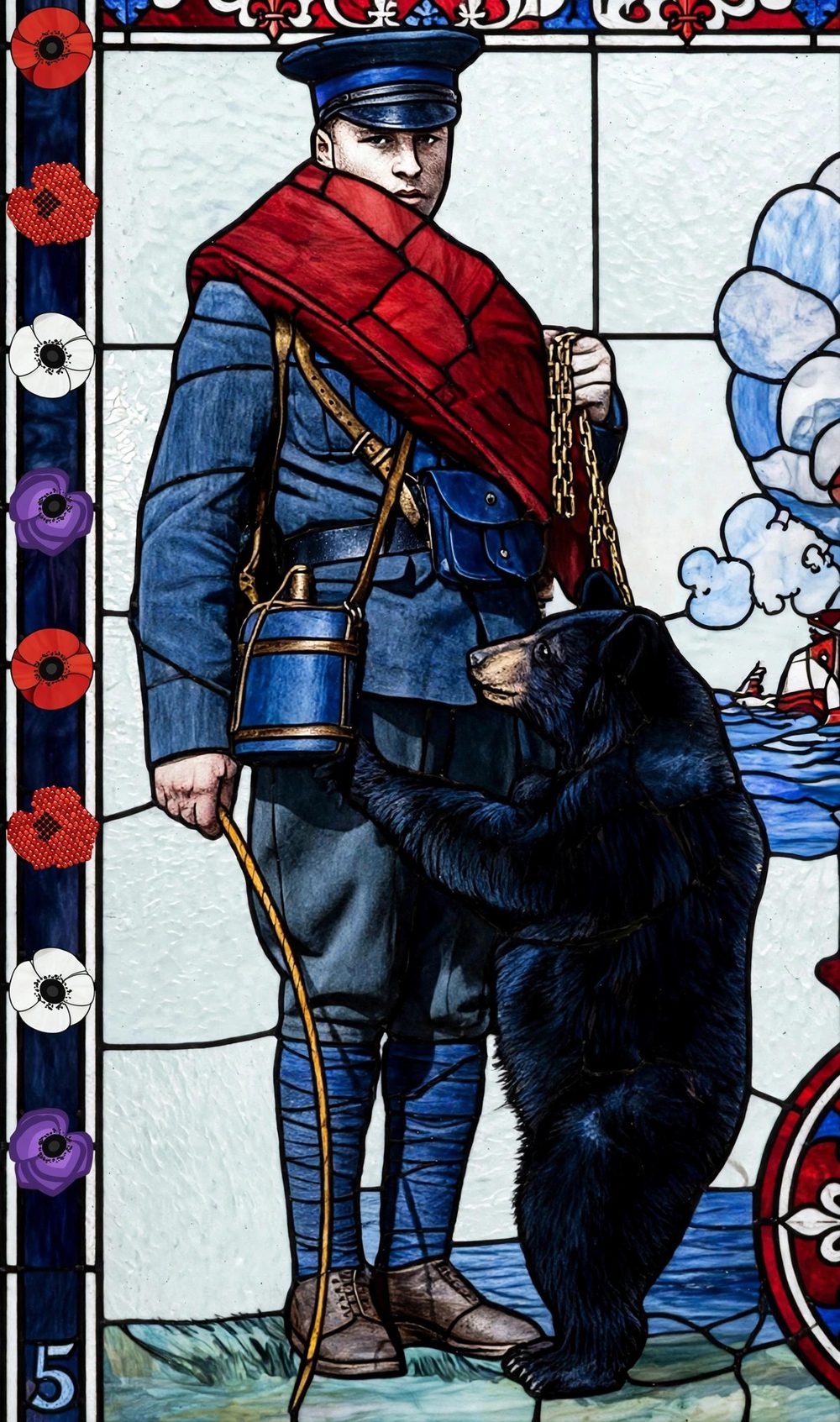
A year on, the cub is a bear: Winnie stands at her full height against a soldier in full kit, who holds her chain. The regiment's pet had grown up with the regiment.Un an plus tard, l’oursonne est une ourse : Winnie se dresse de toute sa taille contre un soldat en équipement complet, qui tient sa chaîne. La mascotte avait grandi avec le régiment.
University of Victoria Archives / Wikimedia Commons, licence as stated on CommonsArchives de l’Université de Victoria / Wikimedia Commons, licence telle qu’indiquée sur Commons
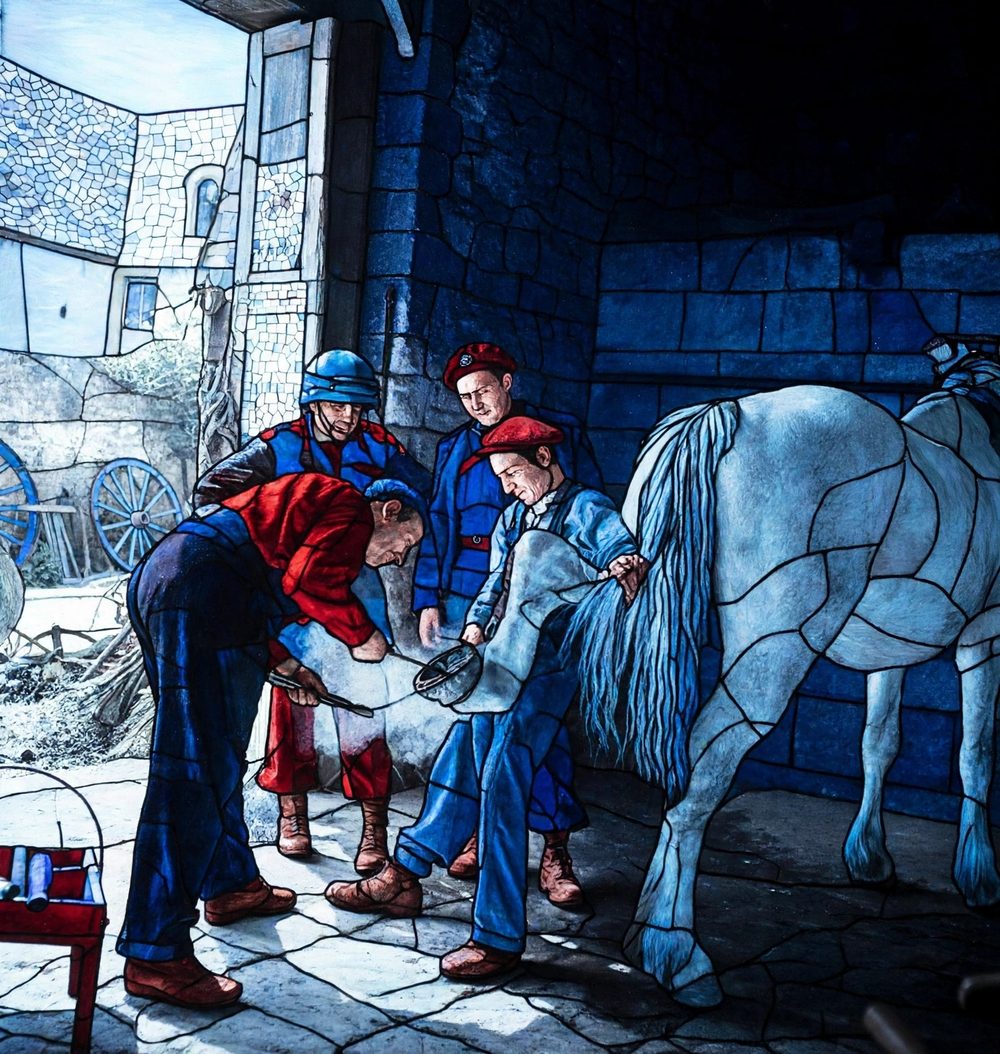
A mechanized army still kept horses — and the farrier's art — in Normandy in 1944. The men of the 7th Canadian Infantry Brigade watch the shoeing the way soldiers have always watched a blacksmith.Une armée mécanisée gardait encore des chevaux — et l’art du maréchal-ferrant — en Normandie en 1944. Les hommes de la 7e Brigade d’infanterie canadienne regardent le ferrage comme les soldats ont toujours regardé un forgeron.
Photo by Lieut. Donald I. Grant / Library and Archives Canada / PA-167887Photo : lieutenant Donald I. Grant / Bibliothèque et Archives Canada / PA-167887
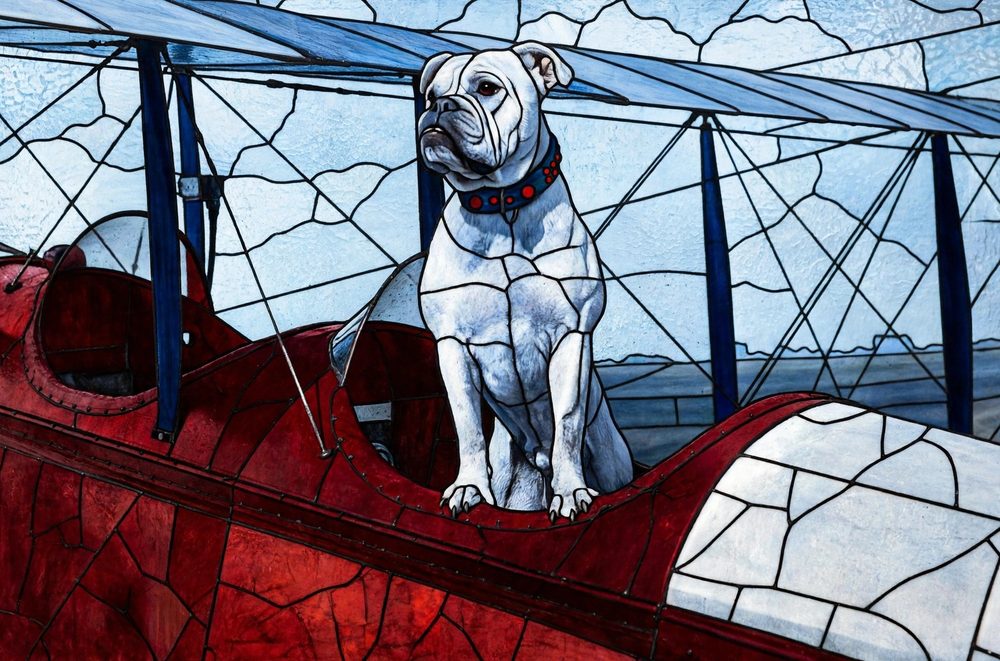
Camp Mohawk, near Deseronto, Ontario, trained Royal Flying Corps pilots — many of them Canadians — and its mascot was a bulldog named John Bull, the same dog in the cockpit on slide 5.Le Camp Mohawk, près de Deseronto, en Ontario, formait les pilotes du Royal Flying Corps — beaucoup de Canadiens — et sa mascotte était un bouledogue nommé John Bull, le même chien que dans le siège du pilote à la diapositive 5.
Photo by Clifton Reynolds / Deseronto Archives, Flickr CommonsPhoto : Clifton Reynolds / Archives de Deseronto, Flickr Commons
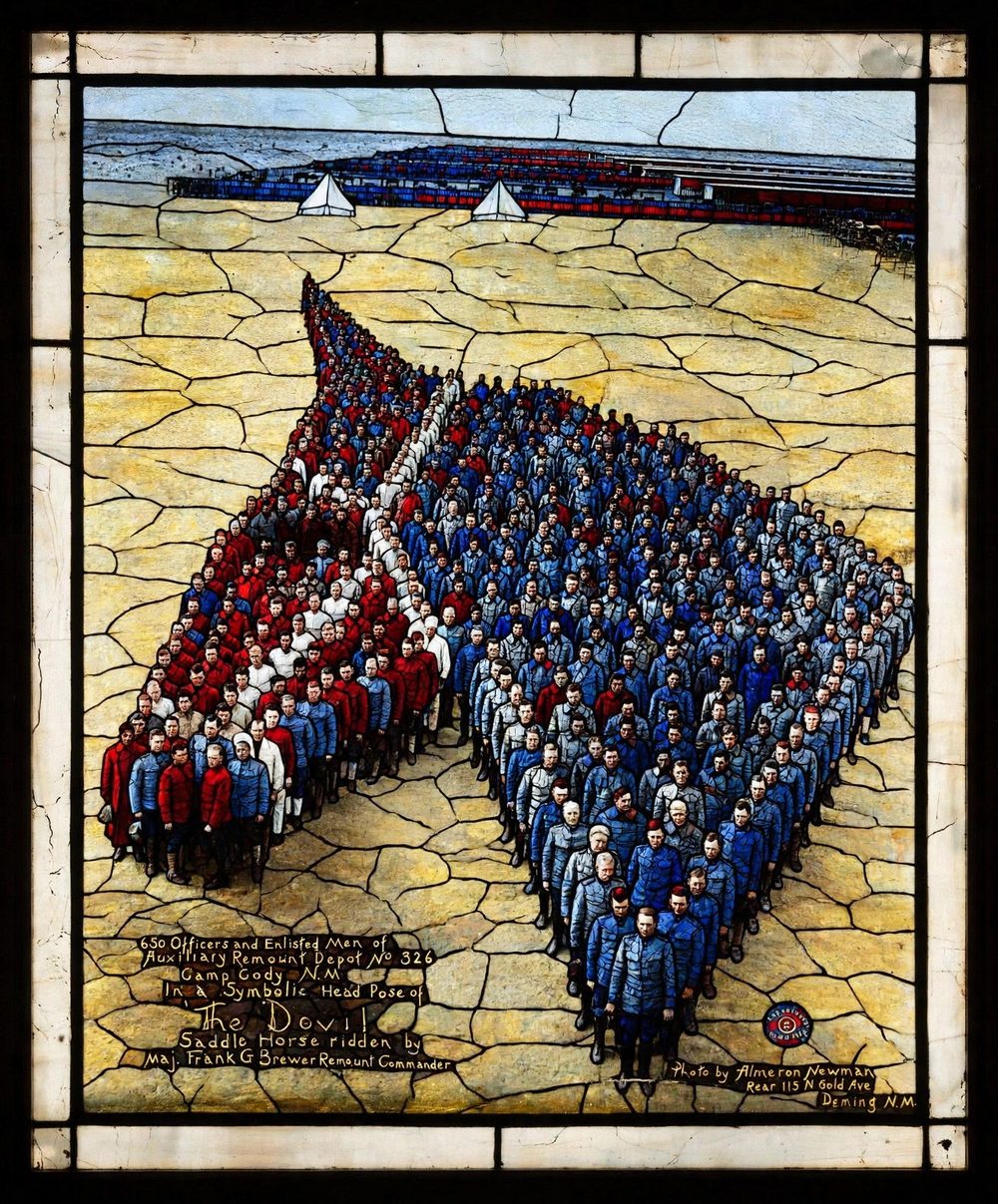
Six hundred and fifty soldiers stand in the shape of a horse's head — "The Devil," their commander's saddle horse — weeks after the war ended. This American photo is our honoured guest — and just after it, Winnie says farewell.Six cent cinquante soldats forment la tête d’un cheval — « The Devil », le cheval de selle de leur commandant — quelques semaines après la fin de la guerre. Cette photo américaine est notre invitée d’honneur — et juste après elle, Winnie fait ses adieux.
Camp Cody, New Mexico, January 1919. Six hundred and fifty soldiers of the Auxiliary Remount Depot No. 326 — men whose daily work was horses — stand in the shape of a horse’s head: “The Devil,” their commander’s saddle horse. Photograph by Almeron Newman; Library of Congress, public domain. The internet often captions this picture as a tribute to the millions of horses, mules, and donkeys that died in the First World War. The record says it honours one horse, weeks after the Armistice. In the years since, it has become the picture people reach for when they grieve all the animals of that war. We print it here with its true caption — honouring the feeling, and the facts.Camp Cody, Nouveau-Mexique, janvier 1919. Six cent cinquante soldats du dépôt de remonte auxiliaire n° 326 — des hommes dont le travail quotidien était les chevaux — forment la tête d’un cheval : « The Devil », le cheval de selle de leur commandant. Photographie d’Almeron Newman; Bibliothèque du Congrès, domaine public. Sur Internet, on présente souvent cette image comme un hommage aux millions de chevaux, de mulets et d’ânes morts pendant la Première Guerre mondiale. Le compte rendu dit qu’elle honore un seul cheval, quelques semaines après l’Armistice. Depuis, elle est devenue l’image que les gens choisissent pour pleurer tous les animaux de cette guerre. Nous la publions ici avec sa vraie légende — pour honorer le sentiment, et les faits.
Photo by Almeron Newman, Camp Cody, New Mexico / Library of Congress, public domainPhoto : Almeron Newman, Camp Cody, Nouveau-Mexique / Bibliothèque du Congrès, domaine public
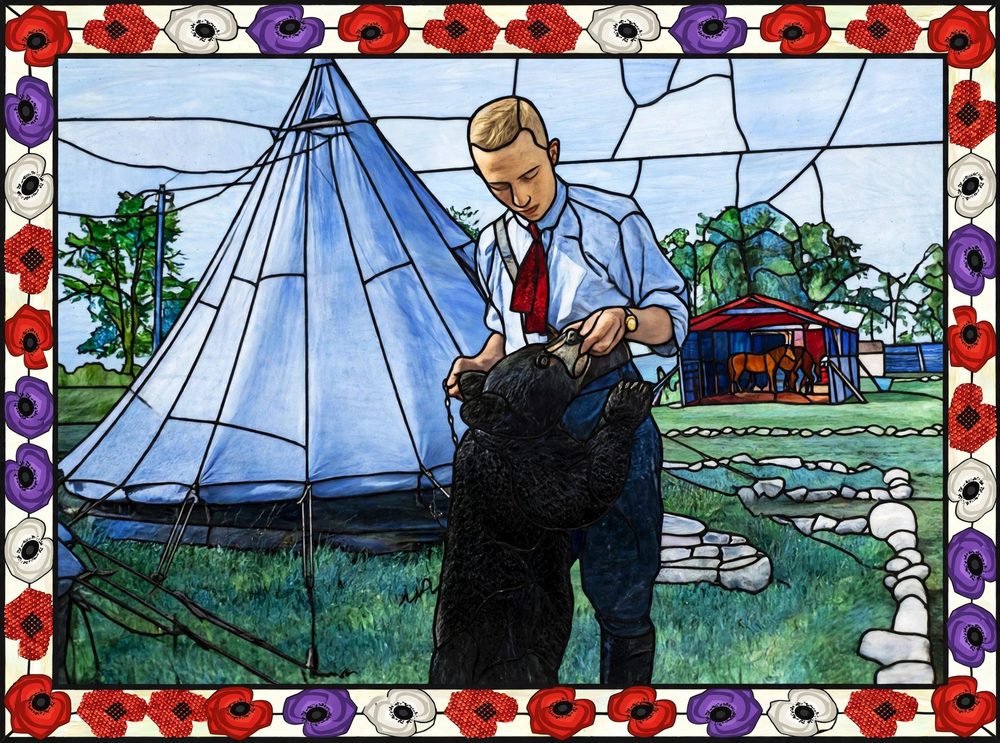
The farewell frame: Colebourn holds Winnie upright by her front paws, and she stands tall — the little bear from Winnipeg, one last time, before the story carries her to London, to Christopher Robin, and to the whole world. She opened this carousel; she closes it.L’image de l’adieu : Colebourn tient Winnie debout par les pattes de devant, et elle se dresse bien droite — la petite ourse de Winnipeg, une dernière fois, avant que l’histoire l’emporte à Londres, vers Christopher Robin, et vers le monde entier. Elle a ouvert ce carrousel; elle le ferme.
Horace Brown fonds / Library and Archives Canada / Item 4386229Fonds Horace Brown / Bibliothèque et Archives Canada / pièce 4386229
Leave your respects: this page holds a standing place for them. Send a name, a unit, or a few words through the doors below — stories by email, tips by Signal — and they will be posted here, by hand, each Remembrance season. Names appear only with permission.
Laissez vos respects : cette page leur garde une place permanente. Envoyez un nom, une unité ou quelques mots par les portes ci-dessous — histoires par courriel, tuyaux par Signal — et ils seront affichés ici, à la main, chaque saison du Souvenir. Les noms ne paraissent qu’avec permission.
Family · Hong Kong, 1941–1945Famille · Hong Kong, 1941–1945
Private Omar James RunnellsLe soldat Omar James Runnells
Winnipeg Grenadiers · Service number H6521Winnipeg Grenadiers · Matricule H6521
Omar James Runnells (1921–1995) of Winnipeg, Manitoba — Matthew's great-uncle — served as a private with the Winnipeg Grenadiers. Taken prisoner at Hong Kong in December 1941, he was held at Shamshuipo and North Point until September 1945, and came home that October. The Hong Kong Veterans Commemorative Association documents him as a Red River Métis veteran.
Omar James Runnells (1921–1995), de Winnipeg, au Manitoba — le grand-oncle de Matthew — a servi comme soldat au sein des Winnipeg Grenadiers. Fait prisonnier à Hong Kong en décembre 1941, il a été détenu à Shamshuipo et à North Point jusqu’en septembre 1945, et il est rentré au pays en octobre de la même année. L’Association commémorative des vétérans de Hong Kong le documente comme un vétéran métis de la rivière Rouge.
Sources: Hong Kong Veterans Commemorative Association (individual report, H6521); Veterans Affairs Canada, National Inventory of Canadian Military Memorials.Sources : Association commémorative des vétérans de Hong Kong (fiche individuelle, H6521); Anciens Combattants Canada, Inventaire national des monuments commémoratifs militaires canadiens.
These are photographs — copies, not cenotaphs. The care we take with them is our own choice, because the people in them served. Before we publish more from them, we've asked Legion Magazine for its guidance. That letter is in preparation.Ce sont des photographies — des copies, pas des cénotaphes. Le soin que nous en prenons est notre propre choix, parce que les personnes qu’on y voit ont servi. Avant d’en publier davantage, nous avons demandé conseil au magazine de la Légion. Cette lettre est en préparation.