“Canada strong. Community first. Truth in plain language.”« Le Canada fort. La communauté d’abord. La vérité en langage clair. »
Independent citizen journalism from Russell, Ontario — public questions, public documents, and the answers (or the silence), posted with dates.Journalisme citoyen indépendant de Russell, en Ontario — des questions publiques, des documents publics, et les réponses (ou le silence), publiées avec les dates.
About MeÀ propos de moi
The founder — kept on his own page, on purpose.Le fondateur — sur sa propre page, à dessein.
Page type: NewsType de page : Nouvelles
Matthew Buechler, founderMatthew Buechler, fondateur
AccessibilityAccessibilité
Matthew Buechler is a veteran, a former performance auditor, a former Statistics Canada analyst, and the founder of Common Good News. He lives in Russell, Ontario.Matthew Buechler est un vétéran, un ancien auditeur de performance, un ancien analyste de Statistique Canada et le fondateur de Bien commun nouvelles. Il vit à Russell, en Ontario.
This page is his. The institution has its own: About CGN.Cette page est la sienne. L’institution a la sienne : À propos de CGN.
The founder is not the ideaLe fondateur n’est pas l’idée
Matthew is the founder. Common Good News is the idea — and the idea belongs to whoever picks it up.Matthew est le fondateur. Bien commun nouvelles est l’idée — et l’idée appartient à qui la ramasse.That is why the two have separate pages. A chapter in another town would copy the idea, not the man.C’est pourquoi les deux ont des pages distinctes. Un chapitre dans une autre ville copierait l’idée, pas l’homme.
How he worksComment il travaille
He is an auditor by training, and it shows in how he thinks about everything else. Before he argues about a word, he tests it: pushes on its edges to see where it breaks, checks what it meant at the time in question, and differentiates only as far as accuracy demands. Then he stops. A definition is a tool, not a wall.Il est auditeur de formation, et cela paraît dans sa façon de penser à tout le reste. Avant de débattre d’un mot, il le teste : il pousse sur ses bords pour voir où il casse, il vérifie ce qu’il voulait dire à l’époque en question, et il ne distingue que jusqu’où l’exactitude l’exige. Puis il arrête. Une définition est un outil, pas un mur.
That is the same method as the Docket: agree on the words, read the record, keep what was claimed separate from what was confirmed, and post the answer with a date.C’est la même méthode que le registre : s’entendre sur les mots, lire le dossier, garder ce qui a été affirmé séparé de ce qui a été confirmé, et publier la réponse avec une date.
What he believesCe qu’il croit
Matthew calls himself, jokingly, a conservative liberal and a liberal conservative. His party, if he has one, is the truth party. Its whole platform is an old schoolyard line: liar, liar, pants on fire. It is aimed at no one — a standard, not a charge. He doesn’t bend on that one.Matthew se décrit, à la blague, comme un libéral conservateur et un conservateur libéral. Son parti, s’il en a un, est le parti de la vérité. Tout son programme tient dans une vieille phrase de cour d’école : menteur, menteur, pantalon en feu. Elle ne vise personne — c’est une norme, pas une accusation. Sur celle-là, il ne plie pas.
Everyone has many identities — Canadian, neighbour, earthling — and no single one of them is the whole person. Identities are ground you stand on, not masks you perform.Chacun porte plusieurs identités — Canadien, voisin, terrien — et aucune d’elles n’est la personne entière. Les identités sont un sol où l’on se tient, pas des masques que l’on joue.
Unity over sorting. We are all, at the root, indigenous to Earth. Belonging is the default condition of being alive, not a prize handed out by a committee.L’unité plutôt que le tri. Nous sommes tous, à la racine, indigènes de la Terre. L’appartenance est la condition par défaut du vivant, pas un prix décerné par un comité.
Adults are free — their loves, their labels, their business.Les adultes sont libres — leurs amours, leurs étiquettes, leurs affaires.
One hard wall: protect the little ones — never harm anyone who cannot decide for themselves.Un seul mur infranchissable : protéger les petits — ne jamais nuire à qui ne peut pas décider pour lui-même.
The tent is the position. Anyone who comes in good faith is welcome in it, including people he disagrees with. We argue now, hug later.La tente est la position. Toute personne de bonne foi y est la bienvenue, y compris des gens avec qui il n’est pas d’accord. On débat maintenant, on s’embrasse plus tard.
His identity model — DNA+ (to be determined)Son modèle d’identité — DNA+ (à déterminer)
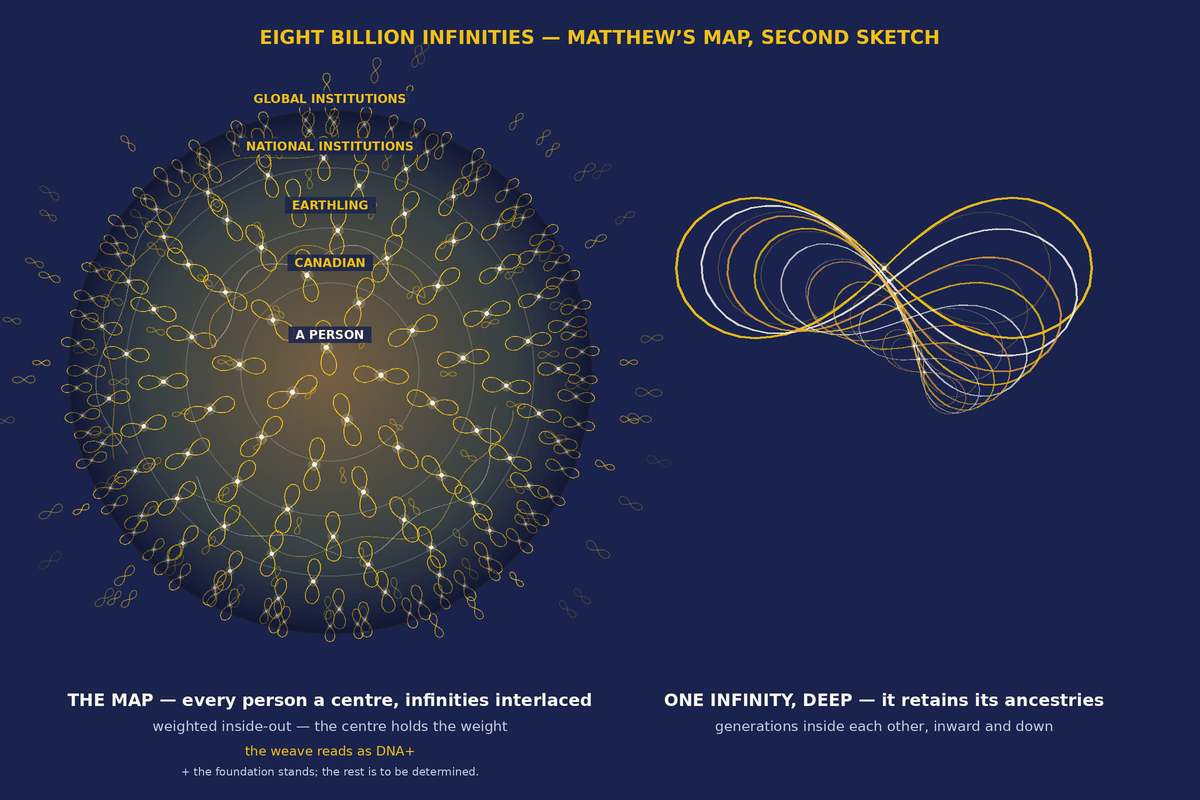
Matthew’s map of everyone — each person at their own centre, the rings of belonging around them, and the weave of all of them, which reads as DNA — carries a plus: DNA+ (to be determined). The plus includes the not-yet-known: “to be determined” stands beside DNA+ at its first use, because what belongs in the set but is not yet named still belongs in it. And the plus means living: what it marks grows as new science comes in and consensus forms — and the plus itself evolves.La carte de tout le monde selon Matthew — chaque personne en son propre centre, les anneaux d’appartenance autour d’elle, et la trame de toutes, qui se lit comme de l’ADN — porte un plus : DNA+ (à déterminer). Le plus inclut le pas-encore-connu : « à déterminer » se tient à côté de DNA+ à son premier usage, parce que ce qui appartient à l’ensemble mais n’est pas encore nommé y appartient toujours. Et le plus veut dire vivant : ce qu’il marque grandit à mesure que la science nouvelle arrive et que le consensus se forme — et le plus lui-même évolue.
Where the Centre of Consciousness Lives
This isn’t a religion, and it isn’t a theory. It’s just how I see people: nobody above anybody.
Every person is the centre of their own infinity — some eight billion of them, interlaced, all the way out to the edge of the Earth.
Nobody sits on top of anybody: everything a person is lives inside the person, and the rings run outward from there — the country, its institutions, then the world’s.
Each infinity runs deep, too: when a person is born a new one joins the map, and when a person dies theirs is not removed — it keeps the ancestries inside it.
The weight sits at the centre and runs inside-out; the institutions at the edge hold none of it.
It is a work in progress, and it has its limits — naming them is part of the map.
Estimated population counters
Numbers that check each other. The world's best published estimates,
shown with their sources, their dates, and their uncertainty left on — because all eyes matter.
Estimated world population — moving
—
United Nations, World Population Prospects 2024. This counter advances the
UN's published estimate at the rate implied by its January 1 anchors — about 2.18 more people
every second, net. It is a model, not a count.
Vintage: UN WPP 2024 (medium variant). Anchors: 8,266,245,291 at January 1, 2026
and 8,335,111,500 at January 1, 2027.
Estimated world population — the UN's published figure
8,300,678,396
United Nations, World Population Prospects 2024 — the UN's estimate for
July 1, 2026. A published figure; it does not move.
Vintage: UN WPP 2024, estimate for July 1, 2026 (medium variant).
Estimated population of Canada — Statistics Canada's published figure
41,798,407
Statistics Canada, The Daily, September 23, 2026. The estimates are
considered preliminary and are based on 2021 Census of Population counts, adjusted for census net
undercoverage and incompletely enumerated reserves and settlements.
Vintage: Statistics Canada estimate for July 1, 2026 (preliminary).
Source: Statistics Canada, table 17-10-0009-01, July 1, 2026. Reproduced and
distributed on an "as is" basis with the permission of Statistics Canada.
CGN's tracker — estimated world population, our interpolation
—
CGN's interpolation of the UN estimate — not a count.
Common Good News runs the same United Nations anchors forward at the same stated
rate, in the open. Same number as the moving counter beside it — the point is that the method is
published, so anyone can rebuild it and check us. See
how this counter works.
Vintage: UN WPP 2024 anchors, January 1, 2026 – January 1, 2027. Method: CGN,
published in the method note.
Estimated population of Canada — moving
—
CGN's interpolation of Statistics Canada's estimates — not a count.
Statistics Canada, table 17-10-0009-01. This counter runs between Statistics
Canada's published quarterly anchors at the pace of the most recent measured quarter —
882.89 people a day, and that pace drives the line. The four-quarter pace,
518.97 people a day, is printed here as the disclosed alternative.
Vintage: Statistics Canada quarterly estimates. Anchors: 41,718,064 at
April 1, 2026 and 41,798,407 at July 1, 2026 (preliminary).
Source: Statistics Canada, table 17-10-0009-01, July 1, 2026. Reproduced and
distributed on an "as is" basis with the permission of Statistics Canada.
Estimated population of Ontario — moving
—
CGN's interpolation of Statistics Canada's estimates — not a count.
Statistics Canada, table 17-10-0009-01. This counter runs between Statistics
Canada's published quarterly anchors at the pace of the most recent measured quarter —
exactly 197 people a day, and that pace drives the line. The four-quarter
pace, 123.73 people a day, is printed here as the disclosed alternative. Statistics Canada's
published figure, which does not move: 16,262,121 (July 1, 2026).
Vintage: Statistics Canada quarterly estimates. Anchors: 16,244,194 at
April 1, 2026 and 16,262,121 at July 1, 2026 (preliminary).
Source: Statistics Canada, table 17-10-0009-01, July 1, 2026. Reproduced and
distributed on an "as is" basis with the permission of Statistics Canada.
Read the digits honestly. The world's statistical agencies disagree about today's
total by roughly 100 million people — the United Nations and the U.S. Census Bureau, the two independent
institutional estimates, sit about that far apart. Treat the last several digits of any moving counter as
motion, not measurement. In Statistics Canada's words for its own modelled figures, data modelled in real
time "are not to be confused with Census counts and demographic estimates."
How these counters are kept. The moving counters run between published anchors. When
a new estimate publishes — a new UN revision, a new Statistics Canada quarter — the counters are re-anchored
to it, and on that day a moving counter may jump, up or down. Statistics Canada warns of the same for its own
clock: recalibrated, its numbers "may show abrupt periodic fluctuations." The jump is the record improving,
and we note it when it happens.
Licence and credit. United Nations, Department of Economic and Social Affairs,
Population Division (2024). World Population Prospects 2024, Online Edition. Used under a Creative
Commons Attribution 3.0 IGO licence (CC BY 3.0 IGO). CGN's moving counters interpolate between the UN's
published January 1 anchors; the interpolation is CGN's, the estimates are the UN's.
Compteurs de population estimée
Des chiffres qui se vérifient les uns les autres. Les meilleures estimations publiées au
monde, montrées avec leurs sources, leurs dates et leur incertitude bien visible — parce que tous les regards
comptent.
Population mondiale estimée — en mouvement
—
Nations Unies, World Population Prospects 2024. Ce compteur fait avancer
l’estimation publiée par l’ONU au taux que donnent ses points d’ancrage du 1er janvier —
environ 2,18 personnes de plus chaque seconde, en solde net. C’est un modèle, pas un dénombrement.
Millésime : ONU, WPP 2024 (variante moyenne). Points d’ancrage : 8 266 245 291 au
1er janvier 2026 et 8 335 111 500 au 1er janvier 2027.
Population mondiale estimée — le chiffre publié par l’ONU
8 300 678 396
Nations Unies, World Population Prospects 2024 — l’estimation de l’ONU pour le
1er juillet 2026. Un chiffre publié; il ne bouge pas.
Millésime : ONU, WPP 2024, estimation pour le 1er juillet 2026 (variante moyenne).
Population estimée du Canada — le chiffre publié par Statistique Canada
41 798 407
Statistique Canada, Le Quotidien, 23 septembre 2026. Dans ses propres mots :
« Les estimations démographiques diffusées aujourd’hui pour le deuxième trimestre de 2026 sont considérées
comme provisoires et seront revues selon le processus usuel utilisé par Statistique Canada depuis des
décennies. Elles sont fondées sur les chiffres du Recensement de la population de 2021, ajustés pour tenir
compte du sous-dénombrement net du recensement et des réserves et établissements partiellement dénombrés. »
Millésime : estimation de Statistique Canada pour le 1er juillet 2026 (provisoire).
Source : Statistique Canada, tableau 17-10-0009-01, 1er juillet 2026. Reproduit et
distribué « tel quel » avec la permission de Statistique Canada.
Le compteur de Bien commun nouvelles — population mondiale estimée, notre interpolation
—
Interpolation de Bien commun nouvelles de l’estimation de l’ONU — pas un dénombrement.
Bien commun nouvelles fait avancer les mêmes points d’ancrage des Nations Unies au même
taux déclaré, au vu de tous. Même nombre que le compteur en mouvement à côté — l’essentiel, c’est que la
méthode est publiée, pour que chacun puisse la refaire et nous vérifier. Voir
comment ce compteur fonctionne.
Millésime : points d’ancrage de l’ONU, WPP 2024, 1er janvier 2026 –
1er janvier 2027. Méthode : Bien commun nouvelles, publiée dans la note méthodologique.
Population estimée du Canada — en mouvement
—
Interpolation de Bien commun nouvelles des estimations de Statistique Canada — pas un dénombrement.
Statistique Canada, tableau 17-10-0009-01. Ce compteur court entre les points
d’ancrage trimestriels publiés par Statistique Canada au rythme du plus récent trimestre mesuré —
882,89 personnes par jour — et c’est ce rythme qui fait avancer la ligne. Le rythme
sur quatre trimestres, 518,97 personnes par jour, est imprimé ici comme solution de rechange déclarée.
Millésime : estimations trimestrielles de Statistique Canada. Points d’ancrage :
41 718 064 au 1er avril 2026 et 41 798 407 au 1er juillet 2026 (provisoires).
Source : Statistique Canada, tableau 17-10-0009-01, 1er juillet 2026. Reproduit et
distribué « tel quel » avec la permission de Statistique Canada.
Population estimée de l’Ontario — en mouvement
—
Interpolation de Bien commun nouvelles des estimations de Statistique Canada — pas un dénombrement.
Statistique Canada, tableau 17-10-0009-01. Ce compteur court entre les points
d’ancrage trimestriels publiés par Statistique Canada au rythme du plus récent trimestre mesuré —
exactement 197 personnes par jour — et c’est ce rythme qui fait avancer la ligne.
Le rythme sur quatre trimestres, 123,73 personnes par jour, est imprimé ici comme solution de rechange
déclarée. Le chiffre publié par Statistique Canada, qui ne bouge pas : 16 262 121 (1er juillet 2026).
Millésime : estimations trimestrielles de Statistique Canada. Points d’ancrage :
16 244 194 au 1er avril 2026 et 16 262 121 au 1er juillet 2026 (provisoires).
Source : Statistique Canada, tableau 17-10-0009-01, 1er juillet 2026. Reproduit et
distribué « tel quel » avec la permission de Statistique Canada.
Lisez les chiffres honnêtement. Les organismes statistiques du monde entier diffèrent
d’environ 100 millions de personnes sur le total d’aujourd’hui — les Nations Unies et le U.S. Census Bureau,
les deux estimations institutionnelles indépendantes, sont à peu près à cette distance l’une de l’autre.
Traitez les derniers chiffres de tout compteur en mouvement comme du mouvement, pas comme une mesure.
Statistique Canada le dit de son propre modèle : « Les données modélisées en temps réel sur cette page Web
ne doivent pas être confondues aux comptes du Recensement et aux estimations démographiques. »
Comment ces compteurs sont tenus. Les compteurs en mouvement courent entre des points
d’ancrage publiés. Quand une nouvelle estimation paraît — une nouvelle révision de l’ONU, un nouveau
trimestre de Statistique Canada — les compteurs sont réancrés sur elle, et ce jour-là un compteur en
mouvement peut sauter, vers le haut ou vers le bas. Statistique Canada prévient de la même chose pour sa
propre horloge : « L’horloge démographique est recalibrée quatre fois par année, afin d’assurer la cohérence
avec les estimations démographiques diffusées trimestriellement. En raison de ce processus de recalibration,
les nombres présentés sur cette page peuvent montrer des fluctuations périodiques abruptes. » Le saut, c’est
le dossier qui s’améliore, et nous le signalons quand il arrive.
Licence et crédit. Nations Unies, Département des affaires économiques et sociales,
Division de la population (2024). World Population Prospects 2024, édition en ligne. Utilisé sous
licence Creative Commons Attribution 3.0 IGO (CC BY 3.0 IGO). Les compteurs en mouvement de Bien commun
nouvelles interpolent entre les points d’ancrage du 1er janvier publiés par l’ONU ; l’interpolation est de
Bien commun nouvelles, les estimations sont celles de l’ONU.
Why a small townPourquoi une petite ville
Russell is chapter zero because truth is easiest to check where you can walk to the record. The method — questions filed in public, answers posted with dates, institutions graded on the paper they produce — is free for any town to copy.Russell est le chapitre zéro parce que la vérité se vérifie le plus facilement là où l’on peut marcher jusqu’au dossier. La méthode — des questions déposées en public, des réponses publiées avec leurs dates, des institutions notées sur le papier qu’elles produisent — est libre d’être copiée par n’importe quelle ville.
Proceed as the way opens.Avancer à mesure que le chemin s’ouvre.
A Canada where everyone belongs, everyone has a say, and every promise is checked.Un Canada où tout le monde a sa place, où tout le monde a son mot à dire, et où chaque promesse est vérifiée.

 Common Good