
 Common Good
The Benchmark · The Whole TableLe barème · Le tableau complet
Seventy of 170: The Published Standards of Ten Canadian News Outlets, CountedSoixante-dix sur 170 : les normes publiées de dix médias canadiens, comptées
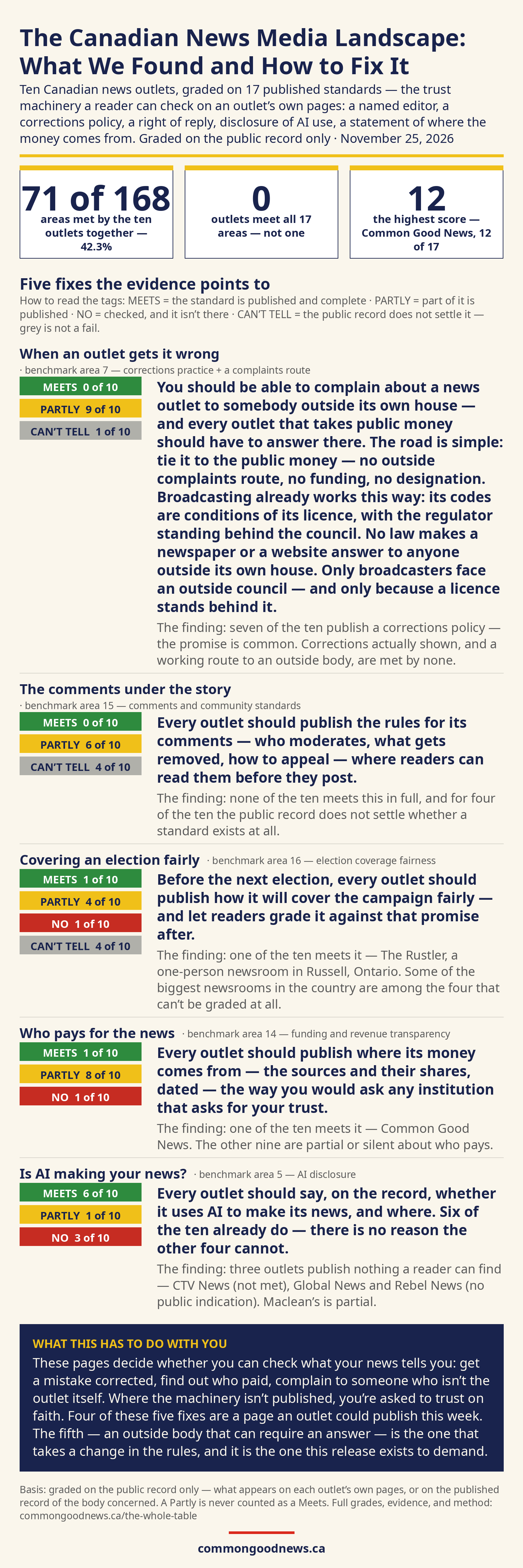
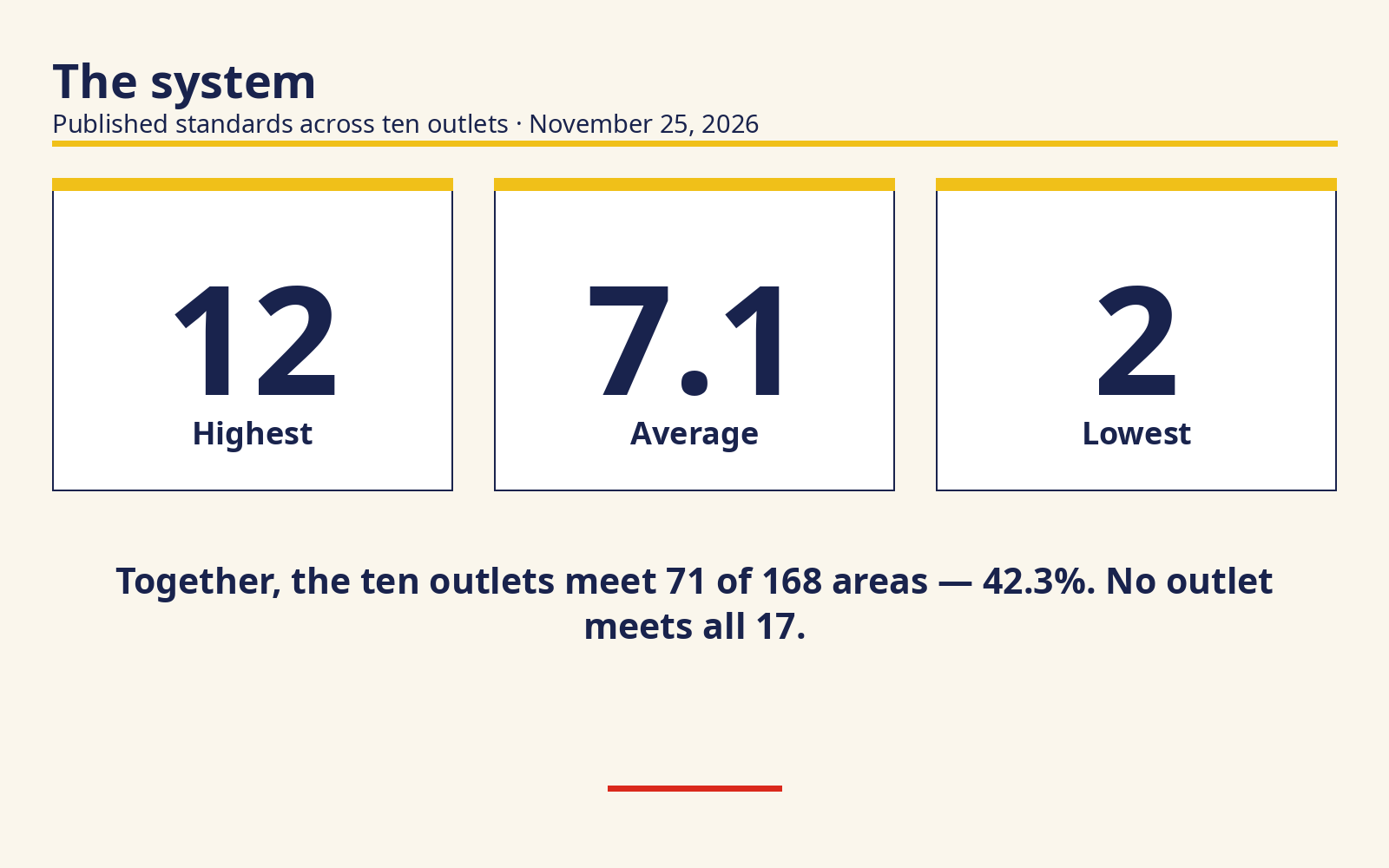
Ten Canadian news outlets were graded on a 17-area benchmark of published journalistic standards. Together they meet 71 of the 168 areas — 42.3%.Dix médias d’information canadiens ont été évalués selon un référentiel de 17 domaines portant sur les normes journalistiques publiées. Ensemble, ils respectent 71 domaines sur 168 — 42,3 %.
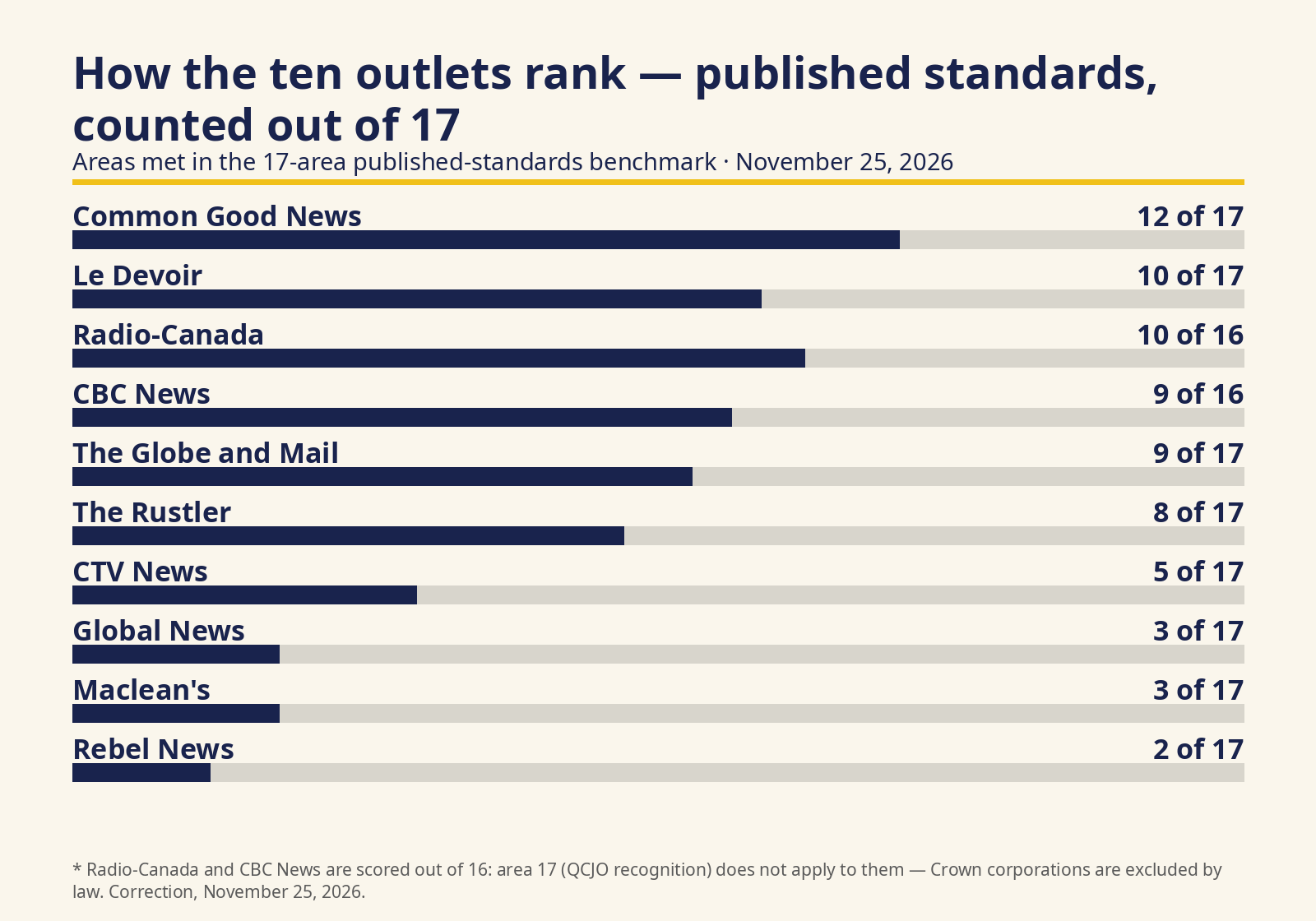
Ten Canadian news outlets were graded on a 17-area benchmark of published journalistic standards. Together they meet 71 of the 168 areas — 42.3%. No outlet meets more than 12. Canada's three biggest national news networks meet 9, 5, and 3.
Dix médias d'information canadiens ont été évalués selon un référentiel de 17 domaines portant sur les normes journalistiques publiées. Ensemble, ils respectent 71 domaines sur 168 — 42,3 %. Aucun n'en respecte plus de 12. Les trois plus grands réseaux nationaux d'information du Canada en respectent 9, 5 et 3.
Correction — November 25, 2026. As first published, this piece scored CBC News and Radio-Canada out of 17 areas. Area 17 — recognition as a qualified Canadian journalism organization — is a designation Crown corporations cannot hold: they are excluded by law (Canada Revenue Agency guidance). The denominators were wrong, and we have corrected them: Radio-Canada is 10 of 16 and CBC News is 9 of 16, and the system's maximum is 168 areas, not 170. No grade changed — only the denominators. The correction is recorded in our public corrections log.
Correction — 25 novembre 2026. À sa parution, cet article notait CBC News et Radio-Canada sur 17 domaines. Le domaine 17 — la reconnaissance comme organisation journalistique canadienne qualifiée — est une désignation que les sociétés d'État ne peuvent pas détenir : elles en sont exclues par la loi (lignes directrices de l'Agence du revenu du Canada). Les dénominateurs étaient erronés, et nous les avons corrigés : Radio-Canada obtient 10 sur 16 et CBC News 9 sur 16, et le maximum du système est de 168 domaines, et non 170. Aucune note n'a changé — seuls les dénominateurs. La correction est consignée dans notre journal public des corrections.
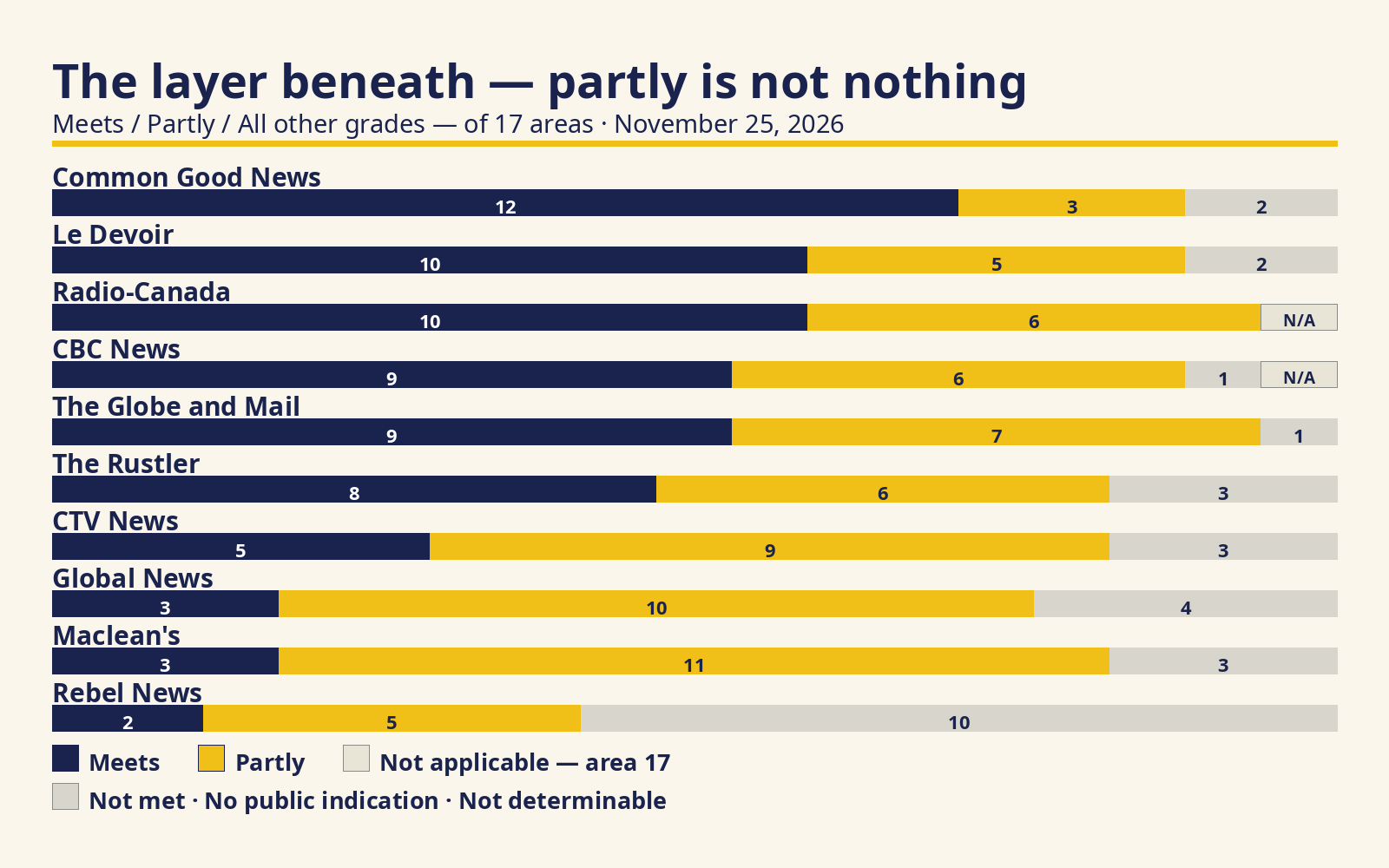
Update — November 25, 2026. After this piece was published, Common Good News published three things its own row was missing: a full contact route, its community and comments standards, and its election-coverage policy. Under the benchmark's own rules, our area 3 now meets the standard, and areas 15 and 16 are gradeable at Partly. Our count is now 12 of 17, and the system total is 71 of 168 areas (42.3%). This is an update, not a correction: the standing was earned after the count was published. The figures in this piece are current as of this update.
Mise à jour — 25 novembre 2026. Après la parution de cet article, Common Good News a publié trois éléments qui manquaient à sa propre ligne : un moyen de contact complet, ses normes communautaires et sur les commentaires, et sa politique de couverture électorale. Selon les règles du référentiel, notre domaine 3 est maintenant respecté, et les domaines 15 et 16 sont évaluables à « partiellement ». Notre décompte est maintenant de 12 sur 17, et le total du système est de 71 domaines sur 168 (42,3 %). Il s'agit d'une mise à jour, non d'une correction : ce statut a été acquis après la publication du décompte. Les chiffres de cet article sont à jour en date de cette mise à jour.
This is not a ranking to celebrate, including at the top. It is a measurement of how much of the machinery of trustworthy news — a named editor, a published corrections policy, a right of reply, a disclosure of AI use, a statement of where the money comes from — a reader can actually inspect at the outlets Canadians rely on. On that public record, most of the machinery is missing, partial, or unpublished. That is fixable, and most of it is cheap to fix. That is why this count exists.
Ce n'est pas un classement à célébrer, y compris en tête. C'est une mesure de la part du dispositif qui rend une information digne de confiance — un rédacteur en chef nommé, une politique de correction publiée, un droit de réponse, une divulgation de l'usage de l'intelligence artificielle, un état des sources de financement — qu'un lecteur peut réellement inspecter aux médias sur lesquels les Canadiens comptent. Sur ce dossier public, la plus grande partie du dispositif est absente, partielle ou non publiée. Cela se corrige, et la plupart des corrections coûtent peu. Voilà pourquoi ce décompte existe.
| Outlet | Areas met |
|---|---|
| Common Good News | 12 of 17 |
| Le Devoir | 10 of 17 |
| Radio-Canada | 10 of 16 |
| CBC News | 9 of 16 |
| The Globe and Mail | 9 of 17 |
| The Rustler | 8 of 17 |
| CTV News | 5 of 17 |
| Maclean's | 3 of 17 |
| Global News | 3 of 17 |
| Rebel News | 2 of 17 |
| Média | Domaines respectés |
|---|---|
| Common Good News | 12 sur 17 |
| Le Devoir | 10 sur 17 |
| Radio-Canada | 10 sur 16 |
| CBC News | 9 sur 16 |
| The Globe and Mail | 9 sur 17 |
| The Rustler | 8 sur 17 |
| CTV News | 5 sur 17 |
| Maclean's | 3 sur 17 |
| Global News | 3 sur 17 |
| Rebel News | 2 sur 17 |
How the count was madeComment le décompte a été fait
The benchmark uses the same 17 areas and the same public-record-only rule as Common Good News's November 22 census of 57 outlets. It grades published standards machinery a reader can verify: what is on the outlet's own pages, or on the published record of the body concerned. Drafts, intentions, and machinery a reader cannot see score nothing. A "Partly" is never counted as a "Meets."
Le référentiel reprend les mêmes 17 domaines et la même règle — le dossier public seulement — que le recensement de 57 médias réalisé par Common Good News le 22 novembre. Il évalue le dispositif de normes publiées qu'un lecteur peut vérifier : ce qui se trouve sur les pages du média lui-même, ou dans le dossier publié de l'organisme concerné. Les brouillons, les intentions et le dispositif qu'un lecteur ne peut pas voir ne valent rien. Un « partiellement » ne compte jamais comme un « respecté ».
Six of the ten outlets were graded fresh on November 25 — CTV News, Global News, The Globe and Mail, Maclean's, Rebel News, and The Rustler — and every fresh grade confirmed the outlet's November 22 census row (five of them cell-for-cell; Global News's count unchanged with one cell improved). Common Good News and Radio-Canada were also graded on November 25. CBC News and Le Devoir carry their November 22 census grades; they were not re-graded in this pass. That difference in grading dates is part of the record.
Six des dix médias ont été évalués à neuf le 25 novembre — CTV News, Global News, The Globe and Mail, Maclean's, Rebel News et The Rustler — et chaque évaluation fraîche a confirmé la ligne du recensement du 22 novembre (cinq d'entre elles cellule par cellule; le total de Global News inchangé, une cellule améliorée). Common Good News et Radio-Canada ont aussi été évalués le 25 novembre. CBC News et Le Devoir conservent leurs notes du recensement du 22 novembre; ils n'ont pas été réévalués dans cette passe. Cette différence de dates d'évaluation fait partie du dossier.
This is Common Good News's benchmark, applied by Common Good News — to itself first, on the same ruler, with its own failures printed in the same table. The method, the area-by-area grades, and the evidence are published so that any reader, including every outlet named here, can reproduce the count or dispute it.
C'est le référentiel de Common Good News, appliqué par Common Good News — à lui-même d'abord, avec la même règle, et ses propres échecs imprimés dans le même tableau. La méthode, les notes domaine par domaine et les preuves sont publiées pour que tout lecteur, y compris chaque média nommé ici, puisse refaire le décompte ou le contester.
What the table showsCe que le tableau montre
The gaps cluster in the same places. Three of the ten publish no corrections policy at all: Global News, Maclean's, and Rebel News. AI disclosure — a published policy a reader can check — is met by six outlets. It is absent at CTV News, unindicated at Global News and Rebel News, and partial at Maclean's. A funding statement a reader can inspect, with sources and proportions, is met by exactly one outlet in the table. The strongest legacy record, The Globe and Mail's — a published editorial code, a real AI policy, a corrections code, press-council membership — still leaves eight areas unmet.
Les lacunes se concentrent aux mêmes endroits. Trois des dix médias ne publient aucune politique de correction : Global News, Maclean's et Rebel News. La divulgation de l'intelligence artificielle — une politique publiée qu'un lecteur peut vérifier — est respectée par six médias. Elle est absente chez CTV News, sans indication publique chez Global News et Rebel News, et partielle chez Maclean's. Un état de financement qu'un lecteur peut inspecter, avec sources et proportions, n'est respecté que par un seul média du tableau. Le dossier hérité le plus solide, celui du Globe and Mail — un code de rédaction publié, une vraie politique sur l'IA, un code des corrections, l'adhésion au conseil de presse — laisse quand même huit domaines non respectés.
Reach and machinery do not travel together. CTV, CBC, and Global are Canada's three biggest national news networks — the top three news brands in the Reuters Institute Digital News Report 2025, at 28%, 26%, and 25% weekly reach among English-speaking respondents. Counted in CBC, CTV, Global order, their counts are 9, 5, and 3. CBC News's 9 includes a published AI disclosure, a corrections policy, and a right of reply; its press-council cell is recorded as not met by design, with a substitute — its Ombudsman, its Journalistic Standards and Practices, and the CRTC. CTV News publishes a genuine standards page and a named masthead of eleven — and no AI policy that a reader can find. Global News meets three areas: sourcing in practice, right of reply, and bylines. Its published standards document is the 2011 edition; a current version is internal.
La portée et le dispositif ne voyagent pas ensemble. CTV, CBC et Global sont les trois plus grands réseaux nationaux d'information du Canada — les trois premières marques d'information selon le Digital News Report 2025 du Reuters Institute, à 28 %, 26 % et 25 % de portée hebdomadaire chez les répondants anglophones. Comptés dans l'ordre CBC, CTV, Global, leurs décomptes sont 9, 5 et 3. Les 9 de CBC News comprennent une divulgation de l'IA publiée, une politique de corrections et un droit de réponse; sa cellule de conseil de presse est consignée comme non respectée par conception, avec un substitut — son ombudsman, ses Normes et pratiques journalistiques et le CRTC. CTV News publie une véritable page de normes et un organigramme nommé de onze personnes — et aucune politique sur l'IA qu'un lecteur puisse trouver. Global News respecte trois domaines : les sources en pratique, le droit de réponse et les signatures. Son document de normes publié est l'édition de 2011; une version à jour est interne.
Size is not the variable. The Rustler, a one-person newsroom in Russell, meets 8 of 17 — ahead of CTV News and Global News — because it publishes its machinery: a methods page that names its editor, states its verification method, discloses its AI use, sets out its corrections practice, and records its right-of-reply record. Its open cells are printed in the same table: it publishes no funding statement of any kind, and there is no public indication of press-council membership. Maclean's, publishing since 1905, meets 3 — it is a press-council member with bylines and dated work, and it publishes no corrections policy; its editor-in-chief's chair is vacant on the current record. Rebel News meets 2 — a published contact route and bylines — with no corrections policy, no published right-of-reply rule, and news, commentary, and crowdfunding appeals intermixed without consistent labelling; its record also carries two $1,500 administrative monetary penalties under the Canada Elections Act over 2019 election-period signs, maintained through appeal. Its qualified Canadian journalism organization designation was refused by the Canada Revenue Agency; the Federal Court upheld that refusal as reasonable in 2024 (2024 FC 1468), and the Federal Court of Appeal dismissed Rebel's appeal in 2026 (2026 FCA 170). Rebel's published position on the scheme is on the record, and this count takes no side in it — it grades the published machinery, and the machinery is what it is.
La taille n'est pas la variable. The Rustler, une rédaction d'une seule personne à Russell, respecte 8 domaines sur 17 — devant CTV News et Global News — parce qu'il publie son dispositif : une page de méthode qui nomme son rédacteur, énonce sa méthode de vérification, divulgue son usage de l'IA, expose sa pratique des corrections et consigne son dossier de droit de réponse. Ses cellules ouvertes sont imprimées dans le même tableau : il ne publie aucun état de financement, et il n'y a aucune indication publique d'adhésion à un conseil de presse. Maclean's, qui publie depuis 1905, en respecte 3 — membre d'un conseil de presse, signatures et dates en règle, et aucune politique de correction publiée; le poste de rédacteur en chef est vacant au dossier actuel. Rebel News en respecte 2 — un moyen de contact publié et les signatures — sans politique de correction, sans règle publiée de droit de réponse, et avec nouvelles, commentaires et appels de sociofinancement entremêlés sans étiquetage constant; son dossier compte aussi deux sanctions administratives pécuniaires de 1 500 $ en vertu de la Loi électorale du Canada pour des affiches en période électorale de 2019, maintenues en appel. Sa désignation d'organisation journalistique canadienne qualifiée a été refusée par l'Agence du revenu du Canada; la Cour fédérale a confirmé ce refus comme raisonnable en 2024 (2024 CF 1468), et la Cour d'appel fédérale a rejeté l'appel de Rebel en 2026 (2026 CAF 170); la position publiée de Rebel sur ce régime est au dossier, et le présent décompte n'y prend pas parti — il évalue le dispositif publié, et le dispositif est ce qu'il est.
At the top of the table, Le Devoir and Radio-Canada meet 10 each — Le Devoir on a transparency page and a trust-held ownership it discloses; Radio-Canada with a constitutive membership in the Conseil de presse du Québec that no other outlet in this table holds in its market. Common Good News meets 12. The next section is about why that number is not the point.
En tête du tableau, Le Devoir et Radio-Canada respectent 10 domaines chacun — Le Devoir grâce à une page de transparence et à une propriété détenue en fiducie qu'il divulgue; Radio-Canada avec une adhésion à titre de membre constitutif du Conseil de presse du Québec qu'aucun autre média de ce tableau ne détient dans son marché. Common Good News en respecte 12. La section suivante explique pourquoi ce chiffre n'est pas l'essentiel.
The point: lift the whole tableL'essentiel : relever tout le tableau
Canada does not have a talent problem in its newsrooms. It has a published-machinery problem, and published machinery is the part any outlet can fix this week. A corrections policy is a page. An AI disclosure is a page. A dated funding statement is a page. A named editor is a line. Common Good News's own count rose from 8 to 11 this month because three such pages went live — byline blocks, type labels, a funding statement. Nothing in that sentence required a bigger newsroom.
Le Canada n'a pas un problème de talent dans ses salles de nouvelles. Il a un problème de dispositif publié, et le dispositif publié est la partie que tout média peut corriger cette semaine. Une politique de correction est une page. Une divulgation de l'IA est une page. Un état de financement daté est une page. Un rédacteur nommé est une ligne. Le propre décompte de Common Good News est passé de 8 à 11 ce mois-ci parce que trois pages de ce genre ont été mises en ligne — des blocs de signature, des étiquettes de type, un état de financement. Rien dans cette phrase n'exigeait une plus grande salle de nouvelles.
What a reader or subscriber can do:
Ce qu'un lecteur ou un abonné peut faire :
- Ask your outlet, where other readers can see it: where is your corrections policy published? Outlets answer public questions.
- Ask whether it discloses AI use, and where. Six of these ten meet the area in full. There is no reason the other four cannot.
- Ask for a dated funding statement — sources and proportions, the way you would ask any institution that asks for your trust.
- Use the routes that exist. Ombudsmen, standards editors, and press councils grade practice only when readers file. A complaint on the record is how a "Partly" becomes a "Meets."
- Subscribe like it matters, and say why. Tell the outlet which standard earned your money. Reader revenue is the loudest signal a newsroom receives.
- Demandez à votre média, là où d'autres lecteurs peuvent le voir : où votre politique de correction est-elle publiée? Les médias répondent aux questions publiques.
- Demandez s'il divulgue son usage de l'intelligence artificielle, et où. Six de ces dix médias respectent pleinement le domaine. Rien n'empêche les quatre autres.
- Demandez un état de financement daté — sources et proportions, comme vous le demanderiez à toute institution qui sollicite votre confiance.
- Utilisez les voies qui existent. Ombudsmans, rédacteurs des normes et conseils de presse n'évaluent la pratique que lorsque les lecteurs déposent des plaintes. Une plainte au dossier est la façon dont un « partiellement » devient un « respecté ».
- Abonnez-vous comme si cela comptait, et dites pourquoi. Dites au média quelle norme a gagné votre argent. Les revenus des lecteurs sont le signal le plus fort qu'une salle de nouvelles reçoive.
What Common Good News is doing about its own row. Our count is 12, and the five cells we do not yet meet are printed in the same table as everyone else's: corrections practice still Partly — one November 20 correction is still missing from our public log, and backfilling it, with its true date, is on us; press-council membership still "No public indication" — our application to the National NewsMedia Council was sent today, and an application is not a membership; comments and election standards now published (in the launch later on November 25) and graded Partly — published is not the same as proven in practice; QCJO recognition not met, for structural reasons we state rather than hide. We publish that list so readers can grade us on it at the next count. Self-application is not a slogan here; it is the entry fee for publishing this table at all.
Ce que Common Good News fait pour sa propre ligne. Notre décompte est 12, et les cinq cellules que nous ne respectons pas encore sont imprimées dans le même tableau que celles de tous les autres : la pratique des corrections encore « partiellement » — une correction du 20 novembre manque toujours à notre journal public, et l'y inscrire, à sa vraie date, nous incombe; l'adhésion au conseil de presse encore « aucune indication publique » — notre demande au National NewsMedia Council a été envoyée aujourd'hui, et une demande n'est pas une adhésion; les normes sur les commentaires et les élections maintenant publiées (lors du lancement, plus tard le 25 novembre) et cotées « partiellement » — publié ne veut pas dire éprouvé en pratique; la reconnaissance comme organisation journalistique qualifiée non respectée, pour des raisons structurelles que nous énonçons au lieu de les cacher. Nous publions cette liste pour que les lecteurs puissent nous évaluer dessus au prochain décompte. L'auto-application n'est pas un slogan ici; c'est le droit d'entrée pour publier ce tableau.
Why a Russell audit house is publishing thisPourquoi une maison d'audit de Russell publie ceci
The Red River Audit is contested work. It counts 4,119 asks in Russell Township's public record from 2013 to 2026 — 3,115 answered, 2,273 done in full, a gap of 842 — and not everyone in Russell welcomes it. We do not ask anyone to take the audit on faith, and this piece is part of the reason no one has to.
Le Red River Audit est un travail contesté. Il dénombre 4 119 demandes dans le dossier public de la Municipalité de Russell de 2013 à 2026 — 3 115 ayant reçu une réponse, 2 273 accomplies en entier, un écart de 842 — et tout le monde à Russell ne l'accueille pas bien. Nous ne demandons à personne de prendre l'audit sur parole, et ce texte fait partie des raisons pour lesquelles personne n'a à le faire.
"Fake news" is answered by evidence or not at all. The audit's method is published in full, in both languages. Its counts are reproducible from the public record — the same record it grades. Its corrections are kept in a public log. And the house that runs it submits its own machinery to the same kind of public count, in the open, including the cells where it fails — which is the table above. When Common Good News reports that a promise made in a council chamber was answered, or was not done, that report comes from a house whose own promises are equally checkable. That is the whole of the claim. Check us the way we check them.
On répond à « fausses nouvelles » par des preuves ou pas du tout. La méthode de l'audit est publiée en entier, dans les deux langues. Ses décomptes sont reproductibles à partir du dossier public — le même dossier qu'il évalue. Ses corrections sont consignées dans un journal public. Et la maison qui le mène soumet son propre dispositif au même genre de décompte public, au vu de tous, y compris les cellules où elle échoue — c'est le tableau ci-dessus. Quand Common Good News rapporte qu'une promesse faite dans une salle de conseil a reçu une réponse, ou n'a pas été accomplie, ce rapport vient d'une maison dont les propres promesses sont également vérifiables. C'est toute l'affirmation. Vérifiez-nous comme nous les vérifions.
The caveats, on the faceLes réserves, au vu de tous
The funding-transparency grade is the closest call in our own row. Our statement gives sources, proportions, concentration, and a review date — reader tips through Ko-fi are 100% of revenue to date; advertising, grants, and sponsorships are none; no single funder has provided 5% or more. It gives proportions, not dollar amounts. A grader who required dollar amounts would hold the area at "Partly" and our count would be 11 of 17 — still first in this table, and stated here so the headline never depends on hiding it.
La note de transparence du financement est l'appel le plus serré de notre propre ligne. Notre état donne les sources, les proportions, la concentration et une date de révision — les pourboires des lecteurs via Ko-fi forment 100 % des revenus à ce jour; publicité, subventions et commandites : aucune; aucun bailleur n'a fourni 5 % ou plus. Il donne des proportions, pas des montants en dollars. Un évaluateur qui exigerait des montants tiendrait le domaine à « partiellement » et notre décompte serait 11 sur 17 — toujours en tête de ce tableau, et énoncé ici pour que le titre ne dépende jamais de le cacher.
Verification limits. Direct fetches to ctvnews.ca, globalnews.ca, macleans.ca, theglobeandmail.com, and rebelnews.com were blocked from this desk during grading; those grades rest on the search-verifiable public record, and The Globe and Mail is additionally paywalled. The Rustler was fetched directly and in full. Radio-Canada's grade, from this morning, rests on the search-verifiable record for the same reason. The cells first in line for re-sampling on a direct-fetch pass are named in the grading memo.
Limites de vérification. L'accès direct à ctvnews.ca, globalnews.ca, macleans.ca, theglobeandmail.com et rebelnews.com a été bloqué depuis ce bureau pendant l'évaluation; ces notes reposent sur le dossier public vérifiable par recherche, et The Globe and Mail est en outre derrière un mur payant. The Rustler a été consulté directement et en entier. La note de Radio-Canada, de ce matin, repose sur le dossier public vérifiable par recherche pour la même raison. Les cellules en tête de liste pour un rééchantillonnage en accès direct sont nommées dans la note d'évaluation.
A press-council application is not membership. Ours was sent November 25. The grade changes only if the Council grants membership.
Une demande au conseil de presse n'est pas une adhésion. La nôtre a été envoyée le 25 novembre. La note ne changera que si le Conseil accorde l'adhésion.
What the result does — and does not — sayCe que le résultat dit — et ne dit pas
The benchmark does not grade the quality, importance, or accuracy of any outlet's reporting. It grades the published machinery of accountability — the part an outlet can put in public before asking to be trusted. On that part, Canada's news system is thinner than its audience deserves: 71 of 168, with the cheapest fixes in journalism sitting unpublished at most of the outlets in this table.
Le référentiel n'évalue ni la qualité, ni l'importance, ni l'exactitude du journalisme d'aucun média. Il évalue le dispositif publié de reddition de comptes — la partie qu'un média peut mettre en public avant de demander qu'on lui fasse confiance. Sur cette partie, le système d'information du Canada est plus mince que ce que son public mérite : 71 sur 168, avec les corrections les moins chères du journalisme toujours non publiées chez la plupart des médias de ce tableau.
Every outlet named here received this count before publication, with an invitation to identify factual error, and any substantive reply will be published with this piece. The grades follow the public record. When the record improves, the count rises — for anyone, including us. That is the invitation this table is making.
Chaque média nommé ici a reçu ce décompte avant publication, avec une invitation à signaler toute erreur factuelle, et toute réponse substantielle sera publiée avec ce texte. Les notes suivent le dossier public. Quand le dossier s'améliore, le décompte monte — pour n'importe qui, y compris nous. C'est l'invitation que ce tableau lance.
Annex: the resources behind the table — staff and budgetsAnnexe : les ressources derrière le tableau — effectifs et budgets
The count above grades published standards, not size. This annex sets out, for each outlet in the table, the staff and money behind the grade — as published, dated, and sourced below — because readers asked what the machinery costs to run. A cell that reads "Not determinable" means no figure at citable strength is on the public record; it is a finding about the record, not an estimate. This annex changes no grade.
Le décompte ci-dessus évalue les normes publiées, pas la taille. La présente annexe expose, pour chaque média du tableau, les effectifs et l'argent derrière la note — tels que publiés, datés et sourcés ci-dessous — parce que des lecteurs ont demandé ce que le dispositif coûte à faire fonctionner. Une cellule qui lit « Non déterminable » signifie qu'aucun chiffre de force citable ne figure au dossier public; c'est un constat sur le dossier, pas une estimation. Cette annexe ne change aucune note.
The ratio, defined on its face. "Areas met per 100 staff" is the outlet's benchmark count divided by its published staff figure, multiplied by 100; "budget per staff member" is its published budget figure divided by the same staff figure. Each ratio is computed only where both of its inputs are published and sourced in this table; where either input is not determinable, the ratio is not determinable either. The budgets in this table are not like-for-like — a parliamentary appropriation, a Crown corporation's total resources, and a private company's revenue are different things — so the ratios compare orders of magnitude only. They are not efficiency verdicts, and they grade nothing.
Le ratio, défini au vu de tous. Les « domaines respectés par 100 employés » sont le décompte du média divisé par son effectif publié, multiplié par 100; le « budget par employé » est son budget publié divisé par le même effectif. Chaque ratio n'est calculé que lorsque ses deux intrants sont publiés et sourcés dans ce tableau; lorsque l'un ou l'autre est non déterminable, le ratio l'est aussi. Les budgets de ce tableau ne sont pas comparables terme à terme — des crédits parlementaires, les ressources totales d'une société d'État et les revenus d'une entreprise privée sont des choses différentes — donc les ratios ne comparent que des ordres de grandeur. Ce ne sont pas des verdicts d'efficacité, et ils ne notent rien.
| Outlet | Areas met | Staff, as published | Budget, as published | Areas met per 100 staff | Budget per staff member |
|---|---|---|---|---|---|
| Common Good News | 12 of 17 | 1 — the Founder & Editor-in-Chief, with an AI assistant (Muse) as research and drafting desk, as disclosed on this page | No dollar figure published. Funding statement (this site): reader tips through Ko-fi are 100% of revenue to date; no single funder has provided 5% or more of revenue to date | 1,200 | Not determinable |
| Le Devoir | 10 of 17 | 165 employees — about 100 of them in the newsroom (Le Devoir, brief to Quebec's Finance Ministry, February 6, 2026) | Not determinable — Le Devoir does not publish financial statements, and no current revenue figure is on the public record | 6.1 | Not determinable |
| Radio-Canada | 10 of 16 | One corporation, CBC/Radio-Canada: over 7,000 employees — permanent, temporary and contract (CBC/Radio-Canada, At a glance, February 2025). No split by service is published; the same figure stands on both rows | One corporation: parliamentary appropriation of $1,407.4M recognized in income, plus $588.7M of self-generated revenue (advertising, subscriber fees and other) — total resources of $1,996.1M, fiscal 2024–25 (CBC/Radio-Canada, Annual Report 2024–25, audited statements). Shown on both rows; it is not two budgets | 0.14 or less | $285,000 or less |
| CBC News | 9 of 16 | One corporation, CBC/Radio-Canada: over 7,000 employees — permanent, temporary and contract (CBC/Radio-Canada, At a glance, February 2025). No split by service is published; the same figure stands on both rows | One corporation: parliamentary appropriation of $1,407.4M recognized in income, plus $588.7M of self-generated revenue (advertising, subscriber fees and other) — total resources of $1,996.1M, fiscal 2024–25 (CBC/Radio-Canada, Annual Report 2024–25, audited statements). Shown on both rows; it is not two budgets | 0.13 or less | $285,000 or less |
| The Globe and Mail | 9 of 17 | A newsroom of 260 people (2026, per the Globe's own published statements; it grew the newsroom by more than 10% in 2025). Total company staff is not published | Not determinable — privately held (Woodbridge); the Globe publishes its revenue mix (63% reader revenue, 2025) but no amounts | 3.5 | Not determinable |
| The Rustler | 8 of 17 | 1 — a one-person newsroom, edited by David Gonczol (The Rustler, "How The Rustler Works," accessed November 25, 2026) | Not determinable — The Rustler publishes no funding or revenue statement | 800 | Not determinable |
| CTV News | 5 of 17 | Not determinable — a division of Bell Media; no CTV News staff count is published | Not determinable — a division of Bell Media (segment figures only); no CTV News budget is published | Not determinable | Not determinable |
| Maclean's | 3 of 17 | Not determinable — a title within St. Joseph Communications, which publishes no title-level staff figure | Not determinable — St. Joseph Communications is privately held and publishes no title-level financials | Not determinable | Not determinable |
| Global News | 3 of 17 | Not determinable — a division of Corus Entertainment; no Global News staff count is published | Not determinable — a division of Corus Entertainment (segment figures only); no Global News budget is published | Not determinable | Not determinable |
| Rebel News | 2 of 17 | 50 staff (Ezra Levant, founder, year-end review, December 2022 — the most recent staff figure Rebel has published; he put it at 60 in April 2022) | Not determinable — privately held; Rebel News publishes no financial statements | 4.0 | Not determinable |
| Média | Domaines respectés | Effectifs, tels que publiés | Budget, tel que publié | Domaines respectés par 100 employés | Budget par employé |
|---|---|---|---|---|---|
| Common Good News | 12 sur 17 | 1 — le fondateur et rédacteur en chef, avec un assistant d'IA (Muse) comme bureau de recherche et de rédaction, comme divulgué sur cette page | Aucun montant en dollars publié. État de financement (ce site) : les pourboires des lecteurs via Ko-fi forment 100 % des revenus à ce jour; aucun bailleur de fonds n'a fourni 5 % ou plus des revenus à ce jour | 1 200 | Non déterminable |
| Le Devoir | 10 sur 17 | 165 employés — environ 100 d'entre eux à la rédaction (Le Devoir, mémoire au ministère des Finances du Québec, 6 février 2026) | Non déterminable — Le Devoir ne publie pas d'états financiers, et aucun chiffre de revenus actuel ne figure au dossier public | 6,1 | Non déterminable |
| Radio-Canada | 10 sur 16 | Une seule société, CBC/Radio-Canada : plus de 7 000 employés — permanents, temporaires et contractuels (CBC/Radio-Canada, At a glance, février 2025). Aucune répartition par service n'est publiée; le même chiffre figure donc aux deux lignes | Une seule société : crédits parlementaires de 1 407,4 M$ comptabilisés en produits, plus 588,7 M$ de revenus autogénérés (publicité, droits d'abonnement et autres) — ressources totales de 1 996,1 M$, exercice 2024-2025 (CBC/Radio-Canada, Rapport annuel 2024-2025, états audités). Inscrit aux deux lignes; il ne s'agit pas de deux budgets | 0,14 ou moins | 285 000 $ ou moins |
| CBC News | 9 sur 16 | Une seule société, CBC/Radio-Canada : plus de 7 000 employés — permanents, temporaires et contractuels (CBC/Radio-Canada, At a glance, février 2025). Aucune répartition par service n'est publiée; le même chiffre figure donc aux deux lignes | Une seule société : crédits parlementaires de 1 407,4 M$ comptabilisés en produits, plus 588,7 M$ de revenus autogénérés (publicité, droits d'abonnement et autres) — ressources totales de 1 996,1 M$, exercice 2024-2025 (CBC/Radio-Canada, Rapport annuel 2024-2025, états audités). Inscrit aux deux lignes; il ne s'agit pas de deux budgets | 0,13 ou moins | 285 000 $ ou moins |
| The Globe and Mail | 9 sur 17 | Une rédaction de 260 personnes (2026, selon les déclarations publiées du Globe; il a accru sa rédaction de plus de 10 % en 2025). L'effectif total de l'entreprise n'est pas publié | Non déterminable — entreprise privée (Woodbridge); le Globe publie la composition de ses revenus (63 % de revenus des lecteurs, 2025), mais aucun montant | 3,5 | Non déterminable |
| The Rustler | 8 sur 17 | 1 — une rédaction d'une seule personne, dirigée par David Gonczol (The Rustler, « How The Rustler Works », consulté le 25 novembre 2026) | Non déterminable — The Rustler ne publie aucun état de financement ni de revenus | 800 | Non déterminable |
| CTV News | 5 sur 17 | Non déterminable — division de Bell Media; aucun effectif propre à CTV News n'est publié | Non déterminable — division de Bell Media (chiffres sectoriels seulement); aucun budget propre à CTV News n'est publié | Non déterminable | Non déterminable |
| Maclean's | 3 sur 17 | Non déterminable — un titre au sein de St. Joseph Communications, qui ne publie aucun effectif par titre | Non déterminable — St. Joseph Communications est une entreprise privée et ne publie aucun résultat financier par titre | Non déterminable | Non déterminable |
| Global News | 3 sur 17 | Non déterminable — division de Corus Entertainment; aucun effectif propre à Global News n'est publié | Non déterminable — division de Corus Entertainment (chiffres sectoriels seulement); aucun budget propre à Global News n'est publié | Non déterminable | Non déterminable |
| Rebel News | 2 sur 17 | 50 employés (Ezra Levant, fondateur, bilan de fin d'année, décembre 2022 — le chiffre d'effectif le plus récent publié par Rebel; il l'établissait à 60 en avril 2022) | Non déterminable — entreprise privée; Rebel News ne publie pas d'états financiers | 4,0 | Non déterminable |
Sources and limits. CBC/Radio-Canada: Annual Report 2024–25 (audited consolidated statements — operating appropriation $1,309.3M, working capital $4.0M, amortization of deferred capital funding $94.1M, recognized government funding $1,407.4M; self-generated revenue $588.7M) and At a glance (February 2025) for staff. Because the corporation states its staff as "over 7,000," both CBC/Radio-Canada ratios are computed on 7,000 and are upper bounds. Le Devoir: the paper's own pre-budget brief to Quebec's Finance Ministry, February 6, 2026. The Globe and Mail: the paper's own published statements on its newsroom, 2025–26; its total staff and its revenue amounts are not published. The Rustler: its own methods page, read in full on November 25, 2026. Rebel News: its founder's own published statements, April and December 2022. Bell Media and Corus Entertainment report consolidated and segment results for BCE and Corus respectively; neither publishes a news-division staff count or budget, and no division figure has been estimated from a parent here. St. Joseph Communications publishes no title-level figures for Maclean's. Staff figures are as each source states them — headcount, newsroom count, or employees including temporary and contract staff — and are not converted to a common basis; that is a second reason the ratios compare orders of magnitude only.
Sources et limites. CBC/Radio-Canada : Rapport annuel 2024-2025 (états consolidés audités — crédits de fonctionnement de 1 309,3 M$, fonds de roulement de 4,0 M$, amortissement du financement d'immobilisations reporté de 94,1 M$, financement public comptabilisé de 1 407,4 M$; revenus autogénérés de 588,7 M$) et At a glance (février 2025) pour les effectifs. La Société énonçant son effectif comme « plus de 7 000 », les deux ratios de CBC/Radio-Canada sont calculés sur 7 000 et constituent des bornes supérieures. Le Devoir : le mémoire prébudgétaire du journal au ministère des Finances du Québec, 6 février 2026. The Globe and Mail : les déclarations publiées du journal sur sa rédaction, 2025-2026; son effectif total et le montant de ses revenus ne sont pas publiés. The Rustler : sa propre page de méthode, lue en entier le 25 novembre 2026. Rebel News : les déclarations publiées de son fondateur, avril et décembre 2022. Bell Media et Corus Entertainment publient des résultats consolidés et sectoriels pour BCE et Corus respectivement; ni l'une ni l'autre ne publie d'effectif ni de budget propre à sa division d'information, et aucun chiffre de division n'a été estimé à partir d'une société mère ici. St. Joseph Communications ne publie aucun chiffre par titre pour Maclean's. Les effectifs sont reproduits tels que chaque source les énonce — effectif total, effectif de rédaction, ou employés y compris temporaires et contractuels — sans conversion à une base commune; c'est une seconde raison pour laquelle les ratios ne comparent que des ordres de grandeur.
Disclosure: I use an AI assistant (Muse) as my principal research and drafting aid. Nothing it produces goes out as-is: I read it, I edit it, and it carries my editorial approval — the judgments are mine. The methodology, including its public corrections log, is published at commongoodnews.ca.
Divulgation : j'utilise un assistant d'IA (Muse) comme principal aide à la recherche et à la rédaction. Rien de ce qu'il produit ne paraît tel quel : je le lis, je le révise, et il reçoit mon approbation éditoriale — les jugements sont les miens. La méthodologie, y compris son journal public des corrections, est publiée à biencommunnouvelles.ca.
— Matthew Buechler, Founder & Editor-in-Chief, Common Good News, Russell, Ontario · November 25, 2026
— Matthew Buechler, fondateur et rédacteur en chef, Common Good News, Russell, Ontario · 25 novembre 2026
DisclosureDivulgation
He discloses his tools openly: Muse, an AI assistant, is his principal research and drafting aid. Nothing it produces goes out as-is — he reads it, he edits it, and it carries his editorial approval. The questions, the filings, and the judgments are his. This project’s methodology, including its public corrections log, is published on this site.Il divulgue ses outils ouvertement : Muse, un assistant d’IA, est son principal outil de recherche et de rédaction. Rien de ce qu’il produit ne sort tel quel — il le lit, il le modifie, et cela porte son approbation éditoriale. Les questions, les dépôts et les jugements sont les siens. La méthodologie de ce projet, y compris son journal public des corrections, est publiée sur ce site.