 Common Good News · commongoodnews.caCommon Good News · commongoodnews.ca
Page type: The Method — Directionality
The Neighbour's Dissent — Common Good News, November 23, 2026
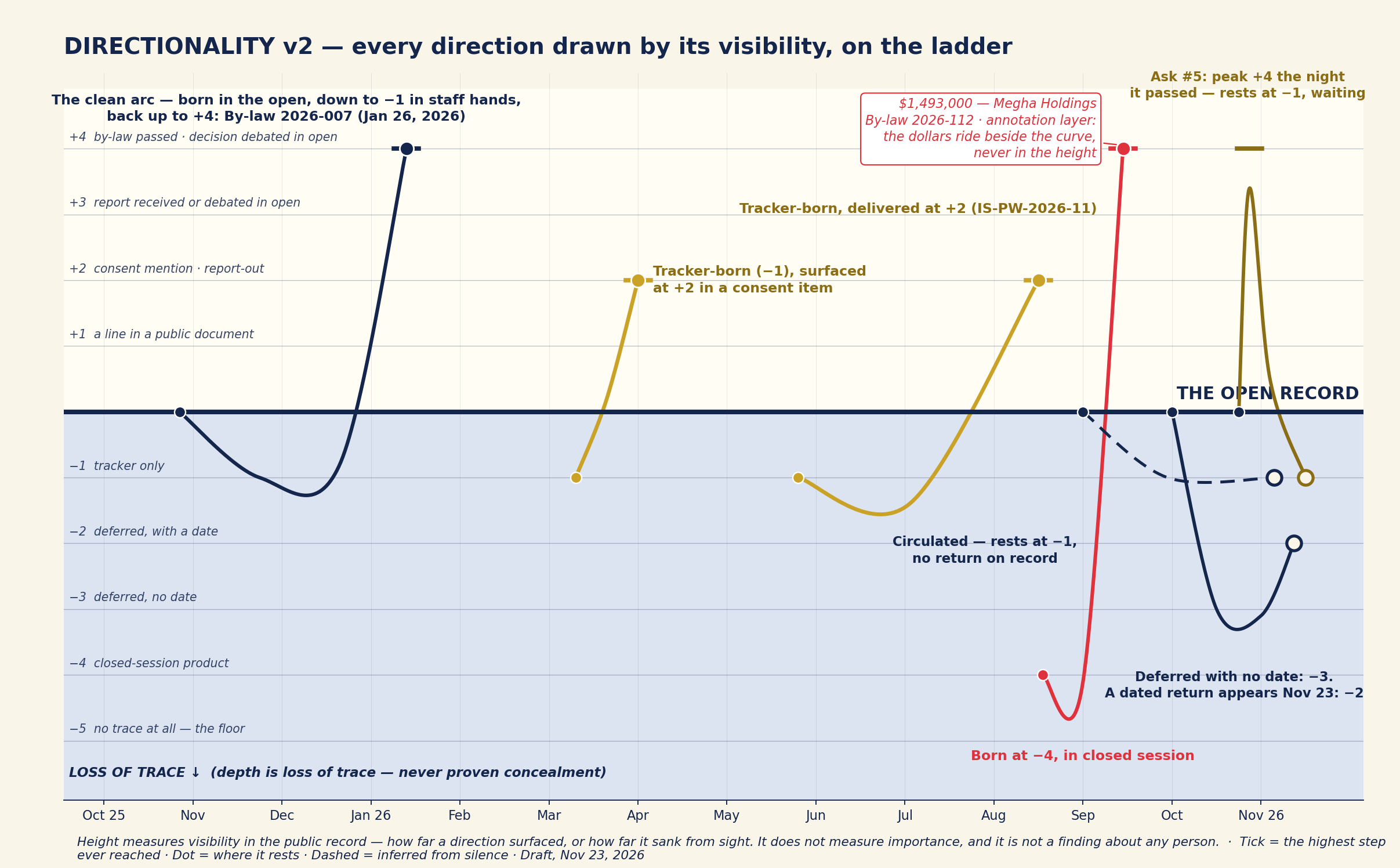
Common Good News is learning to draw a year of Russell Township council meetings as a picture. Every direction Council gave — every look into this, every report back on that — and every ask laid before it, becomes a curve on a page. Time runs left to right. Height is visibility: how far the direction rose into the open record, or how far it sank out of sight. Height is measured on a ladder of steps, and every step has to be something a reader can check. A by-law passed in open session stands at the top; a report received in open session, one step down; a line in the staff tracker, near the waterline. Below it, things sink: deferred, deferred with no date, heard behind a closed door, gone from the record. If this is your first visit, Who checks this news? explains the five lenses in plain words — who they are, and how they check the work.
A ladder like that works — until two directions land on the same step. Then the picture still has to line them up, one ahead of the other, and something has to break the tie.
It happened this year, twice over.
On January 26, 2026, Council received a staff report on a quiet, practical question: what should the Township do about property-tax and utility penalties when the mail stops moving? The report — Canada Post Mail Disruption – Property Tax and Utility Billing Operating Procedures — documented how the penalties were handled during the disruption. It was received for information, and the file closed, answered in part. On paper, that direction touches every household in the township that pays a bill.
Three months later, on April 27, Council received a second report: Traffic Calming on Station Trail. The December before, Council had directed staff to examine a speed hump for that one street and report back. Staff looked, and reported. Council received the report — and refused the hump. The direction was fulfilled; the answer was no. That file, too, closed, answered in part.
Same step. Both reports received in open session. Same kind of paper, same rung of the ladder. So which one stands ahead of the other in the picture?
The panel that advises this newsroom — an editor, a verifier, an auditor, a journalist, and a neighbour — ruled four to one for permanence: inside a step, order by what endures in law. By that measure the billing report walks first. Its procedures are written down and standing; they will govern the next disruption. The trail report enacted nothing. A refusal leaves no instrument behind it. The street stays as it was, and the law of the township is unchanged by a word.
The fifth lens disagreed, and the disagreement is worth more than the vote.
The Neighbour splits the idea of reach in two. There is how many people a direction touches. And there is how hard it touches them. They are not the same measurement.
The billing discretion touches everyone — and will be felt, in the end, by almost no one. A penalty quietly applied, or quietly not applied, during a mail strike most of the township slept through: real, documented, and distant. The speed hump touches one street. But the people on that street live inside the answer. The speed of the cars past the door, the walk, the crossing, the dog on the leash — that was the whole question, and the answer shapes every morning on that street, whichever side of it the street was on. Breadth says the billing file is the bigger thing. Depth says the street is. The Neighbour would put the street first.
The panel's rule stands, and it stands for a good reason. A step on the ladder has to be vouchable. Permanence can be checked: open the report, open the minutes, and the instrument is there or it is not — and two people checking, separately, will get the same answer. How hard it hits them is true, and it is nowhere in the record. Nobody can open it and verify it twice. A picture of the public record has to be built out of the public record, or it is not a picture of the record at all. It is a picture of what we feel about the record, and feelings do not survive an audit.
But the dissent stays on the record beside the rule, unresolved on purpose — because the Neighbour is pointing at the edge of the map, and the edge is real. The ladder measures the record faithfully. The record is not the township. What surfaced is not the same as what mattered, and a newsroom that draws the first should never let the drawing pretend to be the second.
The rule is permanence. The objection is the street. Both are in the file, and the file is better for holding the two of them at once. In this house, the check advises and the founder rules — and the founder has let the dissent stand exactly where it fell: not adopted, not erased. One street, still waiting for its curve to be drawn a little taller than the paper says.
Sourced: both directions are real Completed Register rows — T9 (postal-strike penalty discretion; Report CSAS-FS-2026-01, received for information, January 26, 2026) and T12, limb 1 (Station Trail speed hump; Report IS-PW-2026-09, received April 27, 2026, hump refused) — each graded Closed — answered in part, each delivered as a report received in open session, the same ladder step (+3); the panel's 4–1 permanence ruling and the Neighbour's breadth/depth split are as recorded in the conferral. Illustrated: the street-life colour (cars past the door, the walk, the dog) is narrative framing in the Neighbour's voice — no resident is named, quoted, or described, and no register fact depends on it.
The four load-bearing terms of this picture — direction, visibility, reach, and permanence — are entered in the house Lexicon and used here exactly as entered. The picture's method is part of the Method; the register it draws on is the Docket's Double Entry work, and its landscape is set out in Who Audits Whom in Canada.
Disclosure: Matthew Buechler works with an AI assistant (Muse) as his principal research and drafting aid. Nothing it produces goes out as-is — he reads it, he edits it, and it carries his editorial approval. The questions, the filings, and the judgments are his. This project's methodology, including its public corrections log, is published on this site.
A Canada where everyone belongs, everyone has a say, and every promise is checked.
Common. Good.
News.
The commons, covered.
COMMONGOODNEWS.CA